


Key Takeaways
- After verifying specs on 600+ lifts and drawing from over 200 installations, these are the lifts we’d actually put in our own garages.
- Best overall: BendPak XPR-10AS-168 — 10,000 lb capacity, asymmetric design, ALI certified, built for 20+ years of weekly use.
- Best budget: Triumph NT-9 — full-rise 2-post capability at $1,800-$2,100, less than half the premium price.
- Ceiling height is the #1 constraint. Standard 8-9 foot ceilings limit you to portable or mid-rise lifts. Garages with 11+ feet can run full-size 2-post and 4-post lifts.
- Total installed cost: $1,500 (portable) to $8,250+ (premium 2-post with electrical). Most home buyers spend $3,500-$5,000.
- A quality lift saves $800-$1,500/year in shop labor and pays for itself in 2-4 years.
A car lift turns a home garage from a parking space into a real workspace. Oil changes take 15 minutes instead of 45. Brake jobs go from “I should take it to the shop” to a Saturday morning task. And the $800-$1,500 you save annually in shop labor pays for the lift in 2-4 years.
But buying the wrong lift — wrong type, wrong size, wrong brand for your garage — is an expensive mistake that usually means selling at a loss and starting over. After verifying specs on 600+ lifts and drawing from over 200 real installations, these are our picks for every budget and use case, plus the garage requirements and installation details you need to get it right the first time.
Quick Picks: Our Top Recommendations
| Category | Our Pick | Capacity | Price Range | Why |
|---|---|---|---|---|
| Best overall | BendPak XPR-10AS-168 | 10,000 lbs | $4,200-$5,000 | Premium build, asymmetric, great warranty |
| Best budget | Triumph NT-9 | 9,000 lbs | $1,800-$2,100 | Full-rise 2-post at the lowest real price |
| Best value | Atlas Platinum PV-10P | 10,000 lbs | $2,200-$2,800 | Best mid-range 2-post, strong specs per dollar |
| Best for trucks/SUVs | BendPak XPR-10S-LP | 10,000 lbs | $4,000-$4,800 | Symmetric arms, extra reach for wide frames |
| Best for low ceilings | QuickJack BL-5000SLX | 5,000 lbs | $1,400-$1,600 | Works in any ceiling height, 110V, portable |
| Best for storage | BendPak HD-9 | 9,000 lbs | $3,200-$3,800 | 4-post drive-on, storage + service capable |
| Best portable | QuickJack BL-7000SLX | 7,000 lbs | $2,000-$2,400 | Highest capacity portable, covers trucks |
What to Consider Before Buying
Five factors determine which lift works in your garage. Get any of them wrong and you’re looking at a return, a resale at a loss, or an unsafe installation. Measure first, buy second.
Ceiling Height
The most common dealbreaker. Measure from the floor to the lowest obstruction — garage door track, light fixtures, ceiling joists, or pipes. Not the drywall between obstacles. The lowest point is your effective ceiling height.
| Your Ceiling Height | What Fits |
|---|---|
| 8 feet (96″) | QuickJack portables, mid-rise scissor lifts only |
| 9 feet (108″) | Above + Autostacker overhead, BendPak GP-7LCS |
| 10 feet (120″) | Above + low-profile 2-post options (sedans only) |
| 11 feet (132″) | Most 2-post and 4-post lifts with careful vehicle matching |
| 12+ feet (144″+) | All lift types at full capability |
The math: Your ceiling must clear the lift’s overall height (column top) plus the vehicle height above the arm pads plus 3-6″ safety buffer. A BendPak XPR-10AS (145″ overall) with a Honda Civic (57″ tall) raised to 69″ needs about 145″ at the column — fits under a 12’2″ ceiling. But a Ford F-150 (78″ tall) needs more. The vehicle you’re lifting matters as much as the lift model.
If your ceiling is under 10 feet, focus on mid-rise scissor lifts or QuickJack portables. Above 12 feet, most lifts fit most vehicles. Plug your exact ceiling height and vehicle into the fitment checker for precise model matching.
Concrete Slab
Most 2-post lifts require a minimum 4-inch thick concrete slab with at least 3,000 PSI compressive strength. The anchor bolts transfer thousands of pounds of lateral force — thin or weak concrete can crack, pull out anchors, and cause a tip-over.
| Lift Type | Concrete Minimum | PSI |
|---|---|---|
| QuickJack | None required | N/A |
| Mid-rise scissor | Varies (some: none, some: 4″) | 3,000 |
| 2-post (up to 10K) | 4″ | 3,000 |
| 2-post (12K+) | 6″ | 3,000 |
| 4-post | 4″-6″ | 3,000 |
How to check thickness: Drill a test hole near where the lift columns will sit using a hammer drill with a 1/4″ masonry bit. Measure the hole depth when the bit breaks through. Or check the edge of the slab where the garage floor meets the driveway apron — the thickness is often visible there.
If your slab is under 4 inches: You can pour reinforced concrete pads at each column location ($300-$800) or replace the affected slab sections ($1,000-$2,000+). Most garages built after 1990 have adequate 4-inch slabs. Full details in our concrete requirements guide.
Critical detail: Both lift columns must sit on the same continuous slab. If an expansion joint runs between your planned column positions, the columns can shift independently — a serious safety issue.
Electrical
Most full-rise lifts need 220V single-phase power on a dedicated circuit (NEMA 6-30R outlet). If your garage only has 110V outlets, an electrician runs a new circuit from your panel for $200-$800 depending on distance and local rates.
| Power Need | What’s Required | Cost |
|---|---|---|
| 110V (QuickJack, some mid-rise, Triumph NT-9) | Standard outlet | $0 |
| 220V (most 2-post, all 4-post) | Dedicated circuit, NEMA 6-30R | $200-$800 |
Full electrical requirements, wire gauge specs, and breaker sizing in our installation guide. For a detailed comparison, see our 110V vs. 220V car lift guide.
Floor Space
| Lift Type | Width Needed | Depth Needed | Notes |
|---|---|---|---|
| QuickJack | 8′ | 16′ | Minimal footprint, stores flat |
| Mid-rise scissor | 10′ | 20′ | Platform width + work clearance |
| 2-post | 12′-13′ | 24′ | Column spacing + arm swing + door clearance |
| 4-post | 12′ | 22’+ | Runway length + approach clearance |
A standard 2-car garage (20′ wide x 20-24′ deep) fits a 2-post or 4-post lift in one bay with room for a second vehicle or workspace in the other bay. Single-car garages (10′-12′ wide) can fit a QuickJack or mid-rise scissor but are too narrow for most column lifts.
Common gotcha: Garage door tracks. Measure from the inside edge of your garage door track to where the nearest lift column would sit. You need at least 24 inches. This is the number-one installation complication. A high-lift door conversion ($200-$600) re-routes the tracks to run vertically along the wall, recovering 2-4 inches of usable height — the most common garage modification for lift owners.
Budget
The lift sticker price is only 40-70% of the total project cost. Factor in shipping, installation, and electrical before committing. Here’s the real budget at three tiers:
| Component | Budget Scenario | Mid-Range Scenario | Premium Scenario |
|---|---|---|---|
| Lift | $1,800 (Triumph NT-9) | $2,800 (Atlas PV-10P) | $4,500 (BendPak XPR-10AS) |
| Shipping | $250 | $300 | $350 |
| Installation | $600 | $900 | $1,200 |
| Electrical (220V) | $300 | $350 | $400 |
| Concrete | $0 | $0 | $0 |
| Total | $2,950 | $4,350 | $6,450 |
If concrete work is needed, add $500-$2,000. Full cost breakdown with more scenarios in our car lift cost guide.
Best 2-Post Lifts for Home Garage
A 2-post lift is what 70% of home lift buyers choose. Full wheel-off access, standing-height undercar work, and the smallest footprint for the capability. Here are our top picks.
Best Overall: BendPak XPR-10AS-168
Specs: 10,000 lb capacity | Asymmetric | 168″ overall height | 73″ max rise | 220V/15A | ALI certified
This is the lift we recommend most often for home garages. The asymmetric arm geometry gives you door clearance for comfortable interior and engine bay access while the vehicle is raised. The 10,000 lb capacity handles everything from Miatas to half-ton trucks with comfortable overhead margin.
What we like: Heavy-gauge steel columns, dual-synchro equalization, automatic arm restraint system, excellent hydraulic components (quiet, smooth operation), and BendPak’s industry-leading warranty. The fit and finish is a tier above anything in the budget category — powder coat is thick and durable, welds are clean, and the arms swing smoothly with no slop.
What we’d change: The price. At $4,200-$5,000 before installation, it’s 2x the cost of budget alternatives that lift the same weight. You’re paying for build quality, warranty, brand reputation, and resale value — but the budget lifts get the car in the air just fine.
Best for: Home mechanics who want a 15-20 year lift with minimal maintenance, plan to use it weekly, or value premium build quality. BendPak holds resale value better than any other brand. Browse the full BendPak lineup.
Best Budget 2-Post: Triumph NT-9
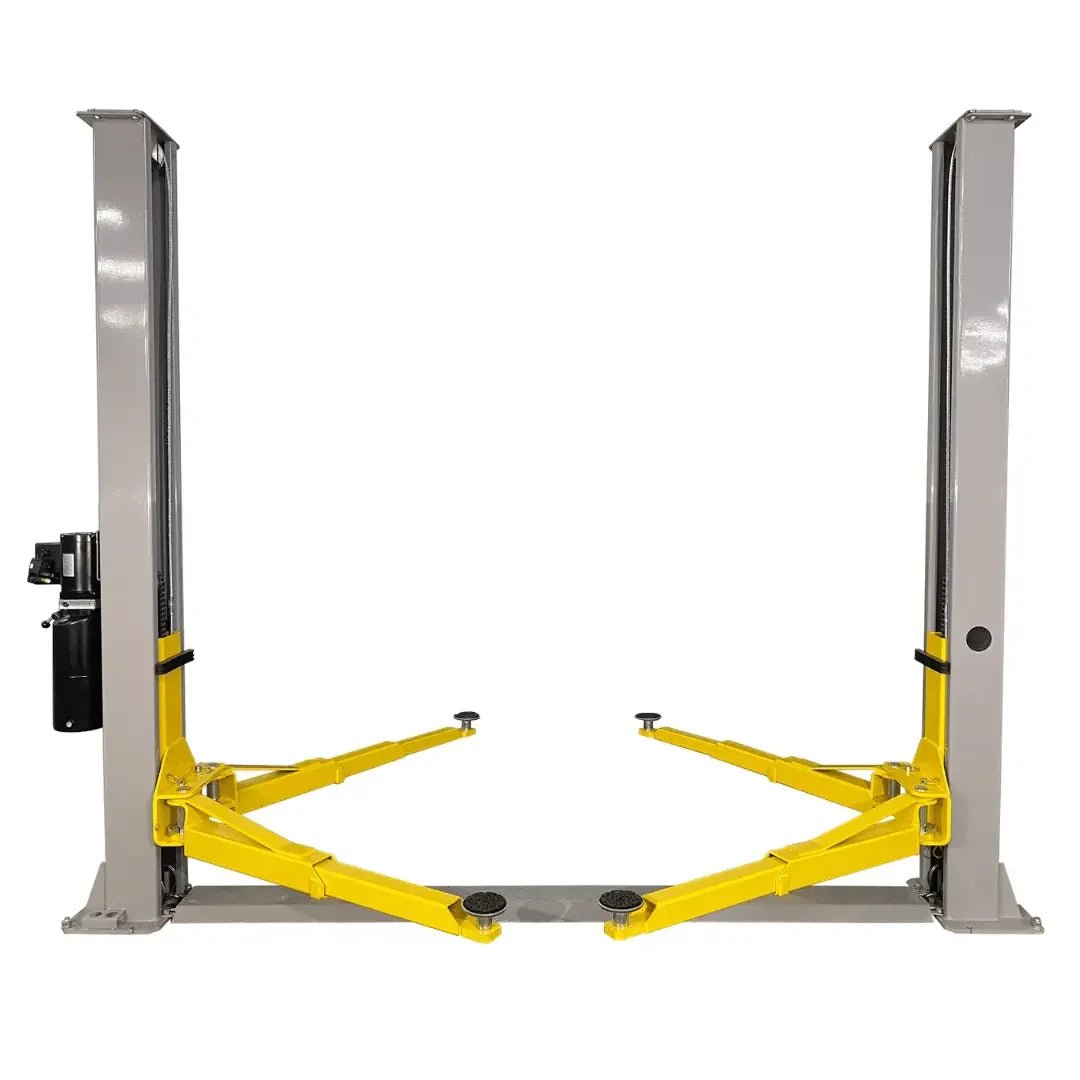
Specs: 9,000 lb capacity | Asymmetric | ~132″ overall height | ~69″ max rise | 220V | ALI certification varies by model
The Triumph NT-9 delivers a full-rise 2-post lift at the lowest legitimate price point in the market. At $1,800-$2,100, it’s less than half the cost of our overall pick while providing the same fundamental capability: raising a car to full height for undercar work.
What we like: Genuine full-rise 2-post capability at a price that makes the “is a lift worth it?” question easy to answer. The 9,000 lb capacity handles everything up to half-ton trucks. Hydraulics are functional and the safety locks work reliably.
What we’d change: The finish quality isn’t BendPak-level — expect some rough edges on the powder coat and less refined arm movement. The hydraulic power unit is louder. Warranty terms aren’t as generous.
Best for: Budget-conscious home mechanics, first-time lift buyers who aren’t sure how much they’ll use it, or anyone who’d rather spend the $2,000+ savings on tools and parts. See how Triumph stacks up in our Triumph vs Atlas comparison.
Best Mid-Range 2-Post: Atlas Platinum PV-10P
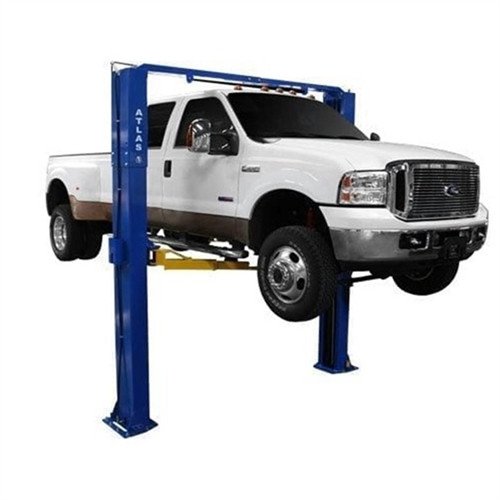
Specs: 10,000 lb capacity | Asymmetric | 220V | ~$2,200-$2,800
The strongest option under $3,000. It delivers 10,000 lb capacity with asymmetric geometry — matching the BendPak XPR-10AS on core specs at roughly half the price. The Atlas brand has established a solid track record in the home garage segment with reliable parts availability and decent customer support.
Best for: Buyers who want 10,000 lb capacity without paying premium prices. It’s the sweet spot between Triumph’s bare-bones approach and BendPak’s premium tier.
Best for Trucks and SUVs: BendPak XPR-10S-LP
Specs: 10,000 lb capacity | Symmetric | Low-profile (140″ overall) | 72″ max rise | 220V | ALI certified
For F-150s, Silverados, Tahoes, and other wide-bodied trucks, symmetric arm geometry is often the better choice. The arms extend equally from both sides of the column, providing longer reach and more balanced weight distribution for vehicles with long wheelbases and heavy front ends.
What we like: The symmetric layout handles the heaviest half-ton trucks and SUVs without the weight-distribution quirks that asymmetric lifts can exhibit with front-heavy vehicles. The LP (low-profile) version keeps the overall height at 140″, which works in many standard garages with sedans.
What we’d change: Symmetric means reduced door clearance — you’ll need to position vehicles carefully if you want to open doors while the car is raised. For trucks this is less of an issue (you’re usually underneath, not inside), but it’s a daily consideration for sedans.
Best for: Dedicated truck and SUV owners, anyone with a 3/4-ton or heavy half-ton. For details on capacity selection, see our 9,000 lb 2-post lift guide. For arm configuration trade-offs, read our asymmetric vs symmetric guide.
| Model | Capacity | Config | Overall Height | Max Rise | Price |
|---|---|---|---|---|---|
| BendPak XPR-10AS-168 | 10,000 lbs | Asymmetric | 168″ | 73″ | $4,200-$5,000 |
| Triumph NT-9 | 9,000 lbs | Asymmetric | ~132″ | ~69″ | $1,800-$2,100 |
| Atlas Platinum PV-10P | 10,000 lbs | Asymmetric | ~144″ | ~72″ | $2,200-$2,800 |
| BendPak XPR-10S-LP | 10,000 lbs | Symmetric | 140″ | 72″ | $4,000-$4,800 |
| Challenger CL10V3 | 10,000 lbs | Symmetric | ~148″ | ~73″ | $4,500-$5,500 |
See our complete best 2-post car lifts rankings for every model scored and compared. For the full 2-post vs 4-post comparison, we cover the decision in detail.
Best 4-Post Lifts for Home Garage
A 4-post lift is the right call if your primary goal is parking two cars in a one-car space, or if you want drive-on convenience with optional service capability. Here are our picks.
Best for Storage: BendPak HD-9
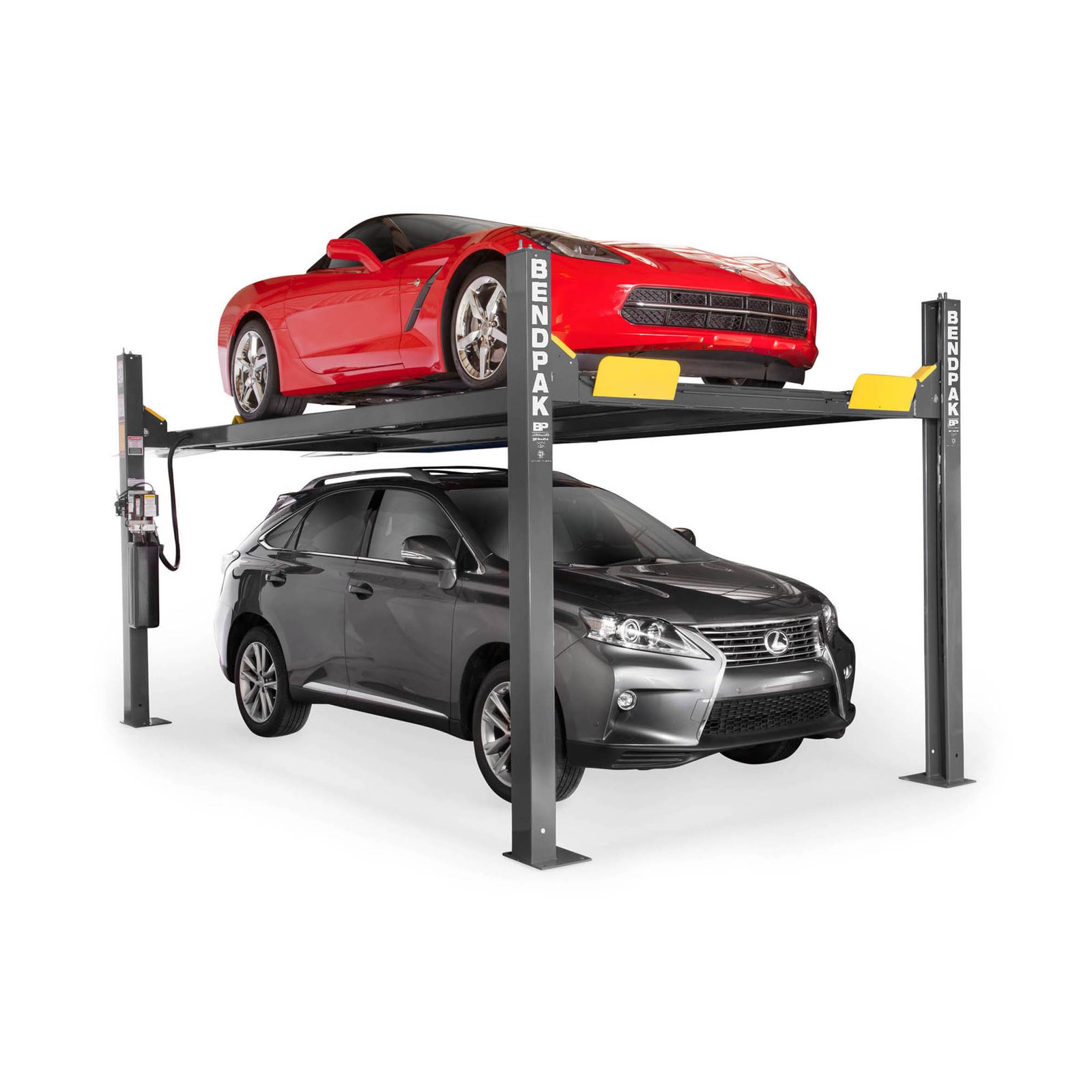
Specs: 9,000 lb capacity | 4-post drive-on | ~82″ platform height | ~60″ max rise | 220V/110V options | ALI certified
The BendPak HD-9 handles both storage and light service work — drive on, raise, park a second vehicle underneath. The 9,000 lb capacity handles virtually any passenger vehicle. Available caster kits allow repositioning the lift in the garage.
What we like: Drive-on convenience (no arm positioning), excellent for daily-driver storage applications, can add optional rolling bridge jacks for wheel-off service work.
What we’d change: The footprint is large — plan for roughly 106″ wide x 200″ long of floor space. Without bridge jacks ($500-$1,000 add-on), you can’t do wheel-off work like brake jobs and tire rotations.
Best for: Car collectors, multi-vehicle households needing parking solutions, anyone who wants storage AND some service capability. See our car storage lift guide.
Heavy-Duty: BendPak HDS-14
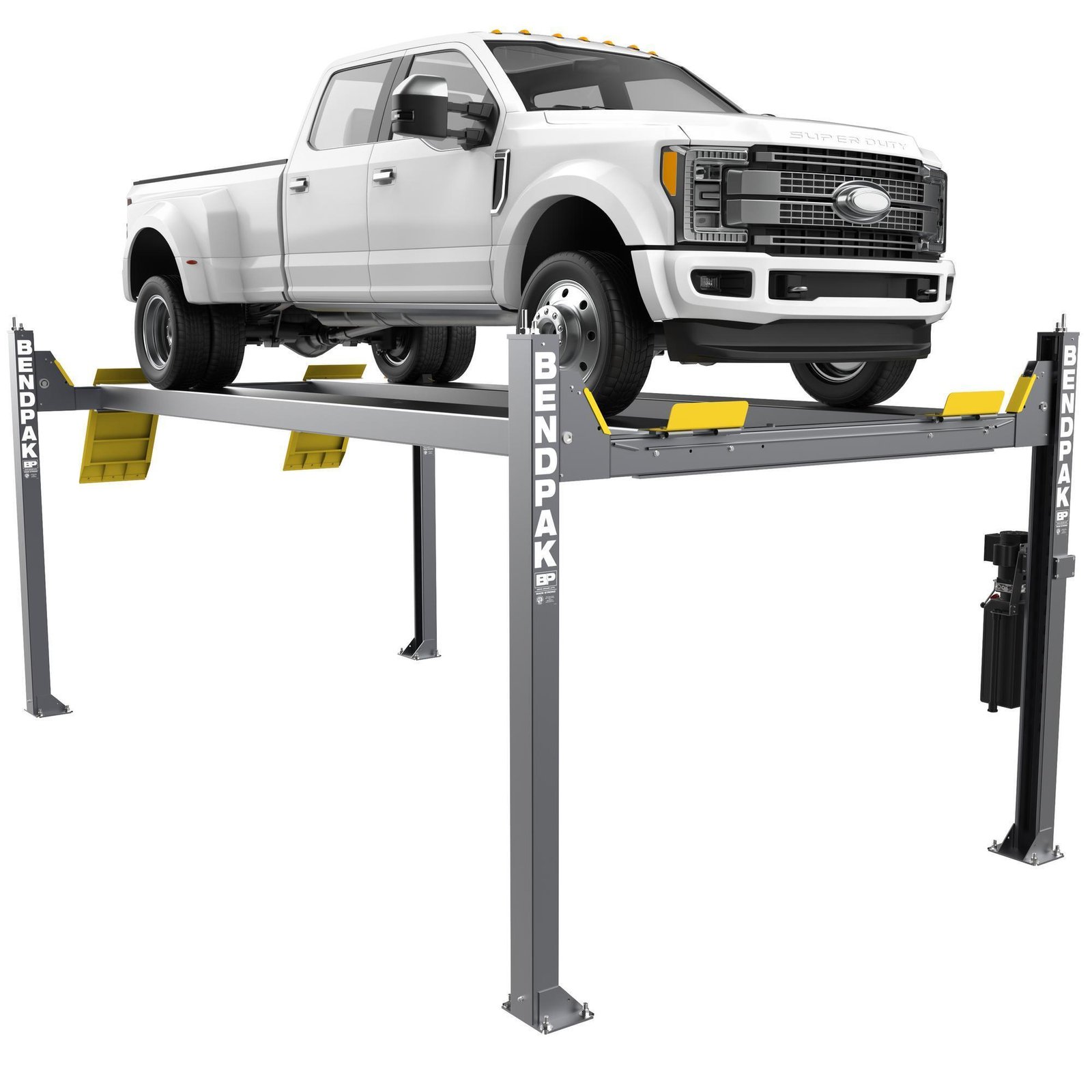
Specs: 14,000 lb capacity | 4-post drive-on | 220V | ALI certified | ~$5,500-$7,000
The go-to 4-post for truck collectors and anyone with vehicles exceeding 9,000 lbs. The HDS-14 handles F-250s, full-size vans, and even light commercial vehicles without breaking a sweat. Massive runway width and length accommodate the longest wheelbases.
Best for: HD truck owners, fleet storage, and commercial-grade home shops.
| Model | Capacity | Best For | Price |
|---|---|---|---|
| BendPak HD-9 | 9,000 lbs | Storage + light service | $3,200-$3,800 |
| BendPak HDS-14 | 14,000 lbs | Heavy-duty trucks, fleet | $5,500-$7,000 |
Browse the full best 4-post car lifts guide.
Best Portable & Scissor Lifts for Home Garage
If your ceiling is under 10 feet, you rent your garage, or you simply want lift capability without permanent installation, portable and scissor lifts are the answer. These also work as secondary lifts alongside a 2-post or 4-post for quick jobs.
Best for Low Ceilings: QuickJack BL-5000SLX
Specs: 5,000 lb capacity | Portable scissor | 21.3″ max rise | 3″ collapsed height | 110V | ~$1,400-$1,600
If your garage ceiling is under 9 feet, full-rise 2-post lifts won’t work. The QuickJack BL-5000SLX is the best compromise: it lifts 5,000 lbs (covering sedans, crossovers, and small SUVs), runs on a standard 110V outlet, and stores flat when not in use.
What we like: Truly portable — one person can set it up in 3-5 minutes. Fits any garage ceiling. 110V means no electrician visit. The 5,000 lb capacity covers the vast majority of passenger vehicles. BendPak build quality (QuickJack is a BendPak brand).
What we’d change: 21.3″ of rise limits you to lying-down work or working from a creeper. Oil changes, brake pads, and tire rotations are comfortable, but exhaust work and transmission jobs are impractical. For more rise in a low ceiling, look at mid-rise scissor lifts.
Best Portable for Trucks: QuickJack BL-7000SLX
Specs: 7,000 lb capacity | Portable scissor | 21.3″ max rise | 220V | ~$2,000-$2,400
The highest-capacity QuickJack covers full-size trucks and SUVs that the 5,000 lb model can’t handle. The right portable lift option for F-150 owners who need lift capability without permanent installation.
What we’d change: Requires 220V, which means an electrician visit for most garages — partially negating the “no installation” advantage. The unit is heavier, making setup slightly more effort. Full comparison of portables in our best portable car lift guide.
Best Mid-Rise: BendPak MD-6XP
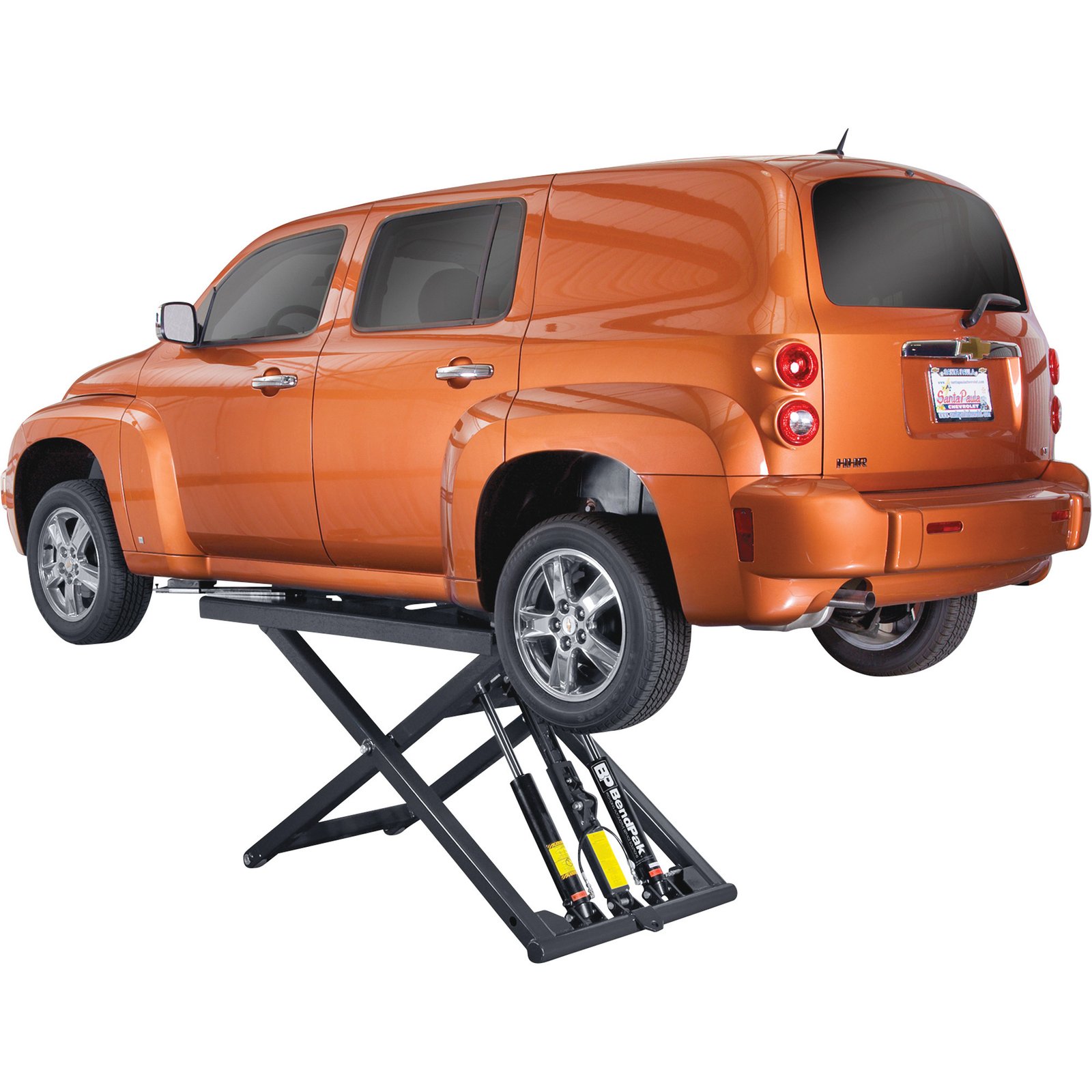
Specs: 6,000 lb capacity | Mid-rise scissor | 48″ max rise | 110V | ~$3,600
Semi-permanent scissor lift that sits flush with the floor when lowered. The 48″ of rise is enough for comfortable standing-height brake, oil, and lower suspension work — a significant upgrade over QuickJack’s 21″ rise. Works in any ceiling 8 feet or higher.
Best for: Homeowners with low ceilings who want a more permanent, higher-rise solution than QuickJack.
| Model | Type | Capacity | Max Rise | Power | Price |
|---|---|---|---|---|---|
| QuickJack BL-3500SLX | Portable | 3,500 lbs | 21.3″ | 110V | ~$1,100-$1,300 |
| QuickJack BL-5000SLX | Portable | 5,000 lbs | 21.3″ | 110V | ~$1,400-$1,600 |
| QuickJack BL-7000SLX | Portable | 7,000 lbs | 21.3″ | 220V | ~$2,000-$2,400 |
| BendPak MD-6XP | Mid-rise scissor | 6,000 lbs | 48″ | 110V | ~$3,600 |
Full analysis in our low-ceiling lift guide | QuickJack review
Every Pick Organized by Budget
Under $2,000
| Model | Type | Capacity | Key Feature | Price |
|---|---|---|---|---|
| QuickJack BL-3500SLX | Portable scissor | 3,500 lbs | 110V, ultra-portable | ~$1,100-$1,300 |
| QuickJack BL-5000SLX | Portable scissor | 5,000 lbs | Best portable value | ~$1,400-$1,600 |
| Triumph NT-9 | 2-post | 9,000 lbs | Cheapest full-rise 2-post | ~$1,800-$2,100 |
$2,000-$4,000
| Model | Type | Capacity | Key Feature | Price |
|---|---|---|---|---|
| QuickJack BL-7000SLX | Portable scissor | 7,000 lbs | Highest portable capacity | ~$2,000-$2,400 |
| Atlas Platinum PV-10P | 2-post | 10,000 lbs | Best mid-range 2-post | ~$2,200-$2,800 |
| Ranger 2-post (various) | 2-post | 9,000-10,000 lbs | BendPak engineering, mid-tier price | ~$2,500-$3,500 |
| BendPak HD-9 | 4-post | 9,000 lbs | Storage + service capable | ~$3,200-$3,800 |
| BendPak MD-6XP | Mid-rise scissor | 6,000 lbs | 48″ rise, works in 8′ ceilings | ~$3,600 |
$4,000+
| Model | Type | Capacity | Key Feature | Price |
|---|---|---|---|---|
| BendPak XPR-10AS-168 | 2-post | 10,000 lbs | Premium benchmark | ~$4,200-$5,000 |
| BendPak XPR-10S-LP | 2-post | 10,000 lbs | Symmetric, low-profile for trucks | ~$4,000-$4,800 |
| Challenger CL10V3 | 2-post | 10,000 lbs | Commercial-grade | ~$4,500-$5,500 |
| BendPak HDS-14 | 4-post | 14,000 lbs | Heavy-duty everything | ~$5,500-$7,000 |
The value play most buyers miss: Ranger is owned by BendPak — same parent company, shared engineering, $500-$1,500 less than BendPak-branded models. For most home buyers, Ranger delivers the optimal price-to-quality ratio.
Garage Requirements & Setup
A home garage isn’t a commercial shop. Your ceiling is probably 8-10 feet instead of 14. Your concrete may be 4 inches instead of 8. Your electrical panel may not have a 220V breaker. Here’s a systematic approach to verifying your garage is lift-ready.
The Decision Framework
Stop thinking about lift types and start thinking about your use case:
- “I do oil changes, brakes, and basic maintenance 6-10 times per year.” — Entry 2-post (Triumph NT-9) or QuickJack BL-5000SLX if your ceiling is low.
- “I want to do everything — suspension, exhaust, engine pulls — and I use my garage as a serious shop.” — Premium 2-post (BendPak XPR-10AS or Challenger CL10V3).
- “I mainly need to store a second car and occasionally do maintenance.” — 4-post (BendPak HD-9) with optional bridge jacks.
- “I have an 8-foot ceiling and can’t modify the garage.” — Mid-rise scissor lift or QuickJack. See our low-ceiling options.
- “I work on an F-150 and need full undercar access.” — 10,000 lb symmetric 2-post (BendPak XPR-10S-LP) and confirm your ceiling height.
- “I rent my garage or can’t permanently modify it.” — QuickJack portable. No installation, stores flat at 3 inches, no anchor bolts.
- “I need maximum versatility.” — A 4-post service lift with bridge jacks AND a QuickJack. The 4-post handles storage and light service; the QuickJack handles quick jobs. Total cost for both: $4,000-$6,000.
Brand Tiers at a Glance
| Tier | Brands | 2-Post Price | Best For |
|---|---|---|---|
| Budget | Triumph, Atlas, Katool | $1,800-$2,500 | First-time buyers, budget-constrained |
| Mid-tier | Ranger (BendPak subsidiary) | $2,200-$3,500 | Best value — BendPak engineering, mid-range price |
| Premium | BendPak, Challenger | $3,500-$8,000 | Long-term ownership, resale value |
Brand comparisons: Atlas vs BendPak | Triumph vs Atlas | Katool vs BendPak | Challenger vs BendPak | All brands
Common Mistakes to Avoid
- Not measuring the ceiling correctly. Measure to the lowest obstruction — garage door tracks, light fixtures, beams, ductwork — not just to the ceiling surface between obstacles.
- Forgetting garage door clearance. The lift columns need 24″+ clearance from the garage door tracks. Check this before ordering.
- Ignoring concrete expansion joints. Both lift columns must sit on the same continuous slab. If an expansion joint runs between your planned column positions, the columns can shift independently — a serious safety issue.
- Buying too little capacity. Buy at least 20% over your heaviest vehicle’s curb weight. A 9,000-lb lift is fine for an F-150 (5,700 lbs max) but leaves zero margin for a Silverado 2500 (7,500 lbs). Err on the side of more capacity.
- Skipping the fitment checker. Our fitment checker cross-references your ceiling height, floor space, and vehicle against every lift model in our database. It takes 30 seconds and prevents expensive mistakes.
Installation Overview & Cost
Professional vs. DIY
Professional installation is recommended for 2-post lifts — column alignment is critical for safe operation and even wear on components. 4-post lifts are more DIY-friendly since the runways self-align during assembly. Portables require no installation at all.
| Lift Type | Install Cost | Time | DIY Feasible? |
|---|---|---|---|
| QuickJack | N/A (self-setup) | 30 minutes | Yes |
| Mid-rise scissor | $300-$600 | 2-4 hours | Yes, with moderate skill |
| 2-post | $400-$1,500 | 4-8 hours | Professional recommended |
| 4-post | $500-$1,500 | 6-10 hours | Yes, with a helper |
Find certified installers in your area through our installer directory, searchable by zip code. Full step-by-step process in our installation guide.
The Payback Calculation
A home mechanic doing their own oil changes, brake pads, tire rotations, and basic inspections saves $800-$1,500 per year in shop labor. On a $4,000 total lift investment, that’s a 2.7-5 year payback period.
After payback, the lift continues saving money for another 10-15+ years. Over its lifetime, a quality lift saves $8,000-$22,500 in avoided shop labor. Plus 12-16 hours per year saved in setup time vs jack stands, standing comfort vs lying on concrete, and access to jobs you currently can’t do at home. Full math in our car lift vs jack stands guide.
Ongoing Maintenance
A car lift needs about 30 minutes of maintenance per month: lubrication, fluid checks, cable inspection, and pad inspection. Annual tasks include a full hydraulic fluid change and comprehensive inspection. Total annual maintenance cost: $60-$120 in materials. A well-maintained lift lasts 20+ years. Full maintenance schedule.
Key Accessories
| Accessory | Price | Essential For |
|---|---|---|
| Correct lift pads | $15-$80 | All lifts — especially Tesla, Corvette, and unibody cars |
| Bridge jacks | $500-$1,000 | 4-post lift owners who want wheel-off capability |
| LED underbody lights | $30-$150 | 2-post lift owners — improves visibility dramatically |
| Drip trays | $15-$40 | All lifts — protects garage floor |
| Caster kits | $150-$400 | 4-post owners who want to reposition the lift |
Full car lift accessories guide.
Permit Requirements
Whether you need a building permit depends on your municipality:
- The electrical work (new 220V circuit) almost always requires a permit and inspection
- The lift installation itself may or may not require a permit depending on local codes
- HOA rules may restrict visible automotive equipment or modifications
- Call your local building department before starting — a 5-minute call prevents headaches and ensures compliance if you sell the property
What We’d Skip
Not every popular lift is a good buy. Here’s what we’d steer people away from:
- Ultra-cheap imports under $1,500 (full-rise 2-post): If a full-rise 2-post lift costs $1,200 when every legitimate model costs $1,800+, something was cut. Usually it’s steel thickness, hydraulic quality, or safety lock reliability. Not worth the risk.
- Overbuilt lifts for home use: A 15,000 lb 2-post lift in a home garage lifting a Honda Accord is money wasted. The extra capacity adds cost, weight, and often height that you don’t need.
- Lifts without clear manufacturer support: If you can’t find a phone number for the manufacturer and spare parts aren’t listed anywhere, walk away. Hydraulic seals, cables, and pads are consumables — you’ll need replacements eventually.
Find the Right Lift for Your Garage
Use our free tools to check garage fitment, compare verified specs across 600+ models, and find a certified installer near you.
Frequently Asked Questions
What is the best car lift for a home garage?
For most home mechanics, the BendPak XPR-10AS-168 is the best overall choice — 10,000 lb capacity, asymmetric design for door clearance, ALI certified, and built to last 20+ years. On a tighter budget, the Triumph NT-9 delivers full-rise 2-post capability at roughly half the price.
Can I put a car lift in my home garage?
Yes, if your garage meets four requirements: adequate ceiling height (10+ feet for most 2-post lifts, 8+ feet for mid-rise scissor lifts), concrete slab at least 4 inches thick, sufficient floor space (11-13′ wide x 22-24′ deep for a 2-post), and electrical capacity for a 220V circuit (or 110V for portable lifts). Use our fitment checker to verify your specific garage.
How much does a home car lift cost installed?
Total installed cost ranges from $1,500 (QuickJack portable, no installation needed) to $8,250+ (premium BendPak 2-post with professional installation and electrical). Most home buyers spend $3,500-$5,000 total. This includes the lift, shipping, professional installation, and a new 220V electrical circuit.
What car lift should I buy for under $3,000?
The Atlas Platinum PV-10P (2-post, ~$2,200-$2,800) is the strongest option under $3,000. It delivers 10,000 lb capacity with asymmetric geometry. For under $2,000, the Triumph NT-9 ($1,800-$2,100) offers 9,000 lbs. Both require 220V power and professional installation, adding $700-$2,000 to the total.
Do I need a 2-post or 4-post lift for my garage?
Choose a 2-post if your primary goal is maintenance and repair — you get full wheel-off access and a smaller footprint. Choose a 4-post if you need vehicle storage or want drive-on convenience. For both storage and service, a 4-post with bridge jacks handles both. Our 2-post vs 4-post guide covers the full decision process.
Is BendPak or Atlas better for a home garage?
BendPak is the premium choice with heavier steel, better finish, quieter hydraulics, and stronger warranty and resale value. Atlas delivers comparable lifting capability at 40-50% lower cost. For weekly use over 15+ years, BendPak’s build quality pays off. For occasional use on a budget, Atlas is a legitimate option. See our full Atlas vs BendPak comparison.
Is a car lift worth it for a home garage?
Yes, if you work on your vehicles more than 4-5 times per year. Annual shop labor savings of $800-$1,500 mean a $3,500-$5,000 total lift investment pays for itself in 2-4 years. Beyond cost savings, a lift makes every job faster (30 seconds vs 15-20 minutes for setup), more comfortable (standing vs lying on concrete), and safer (mechanical locks vs jack stands).
Do I need a permit for a car lift in my garage?
The electrical work (adding a 220V circuit) almost always requires a permit and inspection. The lift installation itself varies by municipality — some classify it as equipment installation (no permit), others require a building permit. HOA rules may also apply. Call your local building department before starting for a definitive answer.
What is the minimum garage size for a car lift?
For a 2-post lift: 12′-13′ wide x 24′ deep minimum. For a 4-post lift: 12′ wide x 22’+ deep. A standard 2-car garage (20′ x 20′ or larger) accommodates any lift type with room for the lift bay plus a second vehicle or workspace. Single-car garages (10′-12′ wide) can fit a QuickJack or mid-rise scissor but are too narrow for most 2-post or 4-post lifts.
What car lift works with 110V power?
The QuickJack portable series (all models), BendPak MD-6XP mid-rise scissor lift, and select 2-post models like the Triumph NT-9 operate on standard 110V household power. No electrician needed. See our 110V vs. 220V guide for the complete list.
Can I install a car lift myself?
QuickJack portable lifts are fully self-install (no tools beyond basic hand tools). Mid-rise scissor lifts can be self-installed with moderate mechanical skill. 2-post and 4-post lifts can technically be self-installed — manufacturers include instructions — but professional installation is recommended for safety verification, proper anchor torquing, and warranty compliance. Find installers at our installer directory.
How do I know if a lift fits my garage?
Measure ceiling height (to the lowest obstruction), bay width, bay depth, and concrete thickness. Then use our fitment checker — enter your dimensions and vehicles, and it shows every compatible lift in our database. It’s the fastest way to eliminate guesswork.