


Key Takeaways
- There are nine distinct types of car lifts, each designed for a specific use case — picking the wrong type means wasting $2,000–$15,000.
- 2-post lifts are the most versatile for service work — full undercarriage access, 9,000–14,000 lb capacity, $2,000–$7,000.
- 4-post lifts are best for storage, parking, and tire/brake service — drive-on convenience, 9,000–14,000 lb capacity, $2,700–$9,000.
- Scissor lifts (low-rise and mid-rise) work in low-ceiling garages — no overhead columns, $1,000–$5,000.
- Portable lifts store away when not in use — QuickJack and MaxJax lead the category, $1,000–$5,200.
- Single-post lifts have the smallest footprint — ideal for collectors maximizing parking density, $2,800–$5,600.
- In-ground lifts disappear into the floor — premium aesthetics, $5,000–$15,000+ plus vault construction.
- Overhead lifts fit standard 9-foot ceilings — zero side posts, $12,000–$15,000.
- Use the fitment checker to match your garage dimensions and vehicles to compatible lifts instantly.
Buying a car lift is a permanent upgrade to how you work on vehicles. No more crawling on cold concrete, no more balancing on jack stands, no more limited access that turns a 30-minute job into two hours of contortion.
But “car lift” covers multiple distinct categories of equipment — and picking the wrong type for your garage, your vehicles, and your work habits is an expensive mistake. A 2-post lift in a garage with 8-foot ceilings won’t work. A 4-post lift when you need full undercarriage access will frustrate you weekly. A portable lift when you’re doing full restorations is a compromise you’ll regret.
Here’s every type of car lift on the market, with verified specs, real price ranges, honest pros and cons, and clear recommendations for who should buy what.
Summary Comparison of All Car Lift Types
| Type | Best For | Capacity Range | Price Range | Max Rise | Min Ceiling | DIY Install? |
|---|---|---|---|---|---|---|
| 2-Post | Maintenance & repair | 7,000–18,000 lbs | $1,800–$8,000 | 69–80″ | 10–14′ | Not recommended |
| 4-Post (service) | Repair + storage | 9,000–18,000 lbs | $3,000–$12,000 | 70–78″ | 10–12′ | Possible |
| 4-Post (storage) | Vehicle stacking | 7,000–9,000 lbs | $2,000–$6,000 | 70–78″ | 10–12′ | Possible |
| Scissor (low-rise) | Quick undercar access | 6,000–10,000 lbs | $1,500–$4,000 | 12–24″ | Any | Yes |
| Scissor (mid-rise) | Brakes, oil, tires | 6,000–9,000 lbs | $2,000–$5,000 | 47–60″ | Any | Yes |
| Portable (QuickJack) | Portable maintenance | 3,500–7,000 lbs | $1,100–$2,400 | 21–24″ | Any | N/A (no install) |
| Portable (MaxJax) | Shared spaces, part-time shops | 6,000–7,000 lbs | $4,500–$5,500 | 47–51″ | 10′+ | Drop-in anchors |
| Single-post | Compact parking | 4,500–7,000 lbs | $2,800–$5,600 | 72–78″ | 10–12′ | Not recommended |
| In-ground | Clean floor, service | 10,000–30,000 lbs | $5,000–$15,000+ | Full rise | Any | Never |
| Alignment | Wheel alignment service | 10,000–14,000 lbs | $5,000–$15,000 | Full rise | 10–14′ | Never |
| Overhead/Platform | Premium storage, condo garages | 6,000 lbs | $12,000–$15,000 | 80–85″ | 9′+ | Never |
1. Two-Post Lifts
Two columns bolted to your garage floor, four adjustable swing arms, and a hydraulic cylinder that raises vehicles to full standing height. This is the lift you see in every professional shop and the most popular type of car lift for serious home mechanics.
How It Works
Each column houses a hydraulic cylinder (or a cable-and-cylinder system) that raises a carriage. Swing arms extend from the carriage and contact the vehicle at its designated lift points — the reinforced spots on the frame or unibody designed to bear the vehicle’s weight. Mechanical safety locks engage automatically every few inches of travel.
Key Specs
- Capacity: 7,000 lbs (light-duty) to 18,000 lbs (commercial heavy-duty). Most home buyers choose 9,000–10,000 lbs.
- Max rise: 69–80 inches depending on model
- Overall height: 111–168 inches (column top)
- Power: 220V single-phase for most models; the Triumph NT-9 runs on 110V
- Concrete: 4″ minimum at 3,000 PSI for lifts up to 10,000 lbs; 6″ for 12,000+ lb models. Concrete guide
- Ceiling requirement: Column height plus vehicle height plus 3–6″ safety buffer
Configurations
- Asymmetric: Arms pivot toward the rear of the column, shifting the vehicle forward for front door clearance. Best for home garages and quick-service bays. Full comparison
- Symmetric: Arms pivot from the column center, centering the vehicle. Better for heavy trucks and high-volume commercial shops.
Representative Models
| Model | Capacity | Overall Height | Price Range |
|---|---|---|---|
| Triumph NT-9 | 9,000 lbs | 111″ (9’3″) | ~$3,200–$3,600 |
| Atlas PV-10PX | 10,000 lbs | 143″–147″ (adjustable) | ~$4,500–$4,700 |
| BendPak XPR-10AS | 10,000 lbs | 145″ (12’1″) | ~$5,800–$6,100 |
Pros
- Full undercarriage access — work on anything from any angle with all four wheels off the ground
- Most versatile lift type — oil changes, brakes, suspension, exhaust, transmission drops, full restorations
- Compact footprint — two columns take less floor space than a 4-post
- Wide capacity range — models from 7,000 to 18,000 lbs cover every passenger vehicle and most trucks
- Widest model selection — more brands and configurations than any other lift type
- Strong resale value — a used BendPak 2-post holds 60–70% of its retail value
Cons
- Ceiling height — standard models need 12′+ ceilings; low-profile models like the Triumph NT-9 (111″ overall) bring that down to roughly 9′3″ at the column, but you still need clearance above the lifted vehicle
- Permanent installation — concrete anchor bolts mean you’re committed to a location
- 220V electrical — most models require a dedicated 220V circuit ($300–$800 to install if you don’t have one)
- No storage capability — unlike a 4-post, you can’t park a second vehicle underneath
- Arm positioning requires knowledge — each vehicle has specific lift points that must be used correctly
Who Should Buy a 2-Post Lift
Anyone doing regular service and maintenance work. If you wrench on weekends, do your own oil changes, swap brakes, replace suspension components, or work on exhaust systems, a 2-post lift is the gold standard. It’s also the right choice for restoration projects where you need to access every part of the undercarriage over weeks or months.
Not ideal if: Your primary goal is parking two cars in a single bay, your ceiling is under 9 feet, or you rent and can’t drill into the floor.
Browse all 2-post lifts | Best 9,000 lb options | 2-post buyer’s guide
2. Four-Post Lifts (Service)
Four columns connected by two long runways. Drive the vehicle onto the runways — no arm positioning, no lift-point hunting — and the platform rises. Service-grade 4-post lifts are built for regular maintenance use and can accommodate optional bridge jacks for wheel-off work.
How It Works
The vehicle drives onto two parallel runways (like driving onto a ramp). A hydraulic cylinder raises all four columns simultaneously. The vehicle sits on the runways by its tires, with its weight distributed across the full wheelbase. Mechanical safety locks engage at set intervals. To do tire-off work (brake jobs, tire rotations), you need optional rolling bridge jacks — secondary jacks that sit on the runways and lift the vehicle off its tires by the frame, freeing the wheels.
Key Specs
- Capacity: 9,000 lbs (standard) to 18,000 lbs (heavy-duty)
- Max rise: 70–78 inches
- Runway length: 170–242 inches depending on model
- Power: 220V single-phase
- Concrete: 4–6 inches at 3,000 PSI (some models can be freestanding without anchoring)
- Ceiling requirement: Column height plus vehicle height plus buffer
Representative Models
| Model | Capacity | Overall Length | Price Range |
|---|---|---|---|
| BendPak HD-9 | 9,000 lbs | ~185″ | ~$6,100 |
| Atlas 412 | 12,000 lbs | ~220″ | ~$7,000 |
| BendPak HDS-14 | 14,000 lbs | 242″ | ~$8,300–$8,600 |
Pros
- Easiest to use — drive on and press a button, no arm positioning required
- Dual-purpose — store one car on the lift, park another underneath
- Most stable platform — four columns and full runway contact provide maximum stability
- Some models freestanding — can be placed without concrete anchoring (though anchoring is recommended)
- Safer for inexperienced users — no risk of misplacing lift arms on wrong contact points
- Optional caster kits — some models can be repositioned within the garage
Cons
- Large footprint — four columns plus runways take significantly more floor space than a 2-post
- Limited undercarriage access — the runways block center access; you need rolling bridge jacks ($500–$1,200 additional) for tire-off work
- Higher price floor — budget 4-post lifts start around $2,700, but quality service models run $6,000–$9,000
- Heavy and permanent — shipping weights run 1,500–2,500+ lbs; moving one requires disassembly
Who Should Buy a 4-Post Service Lift
Car collectors who need to stack vehicles. Garages where parking density matters as much as service capability. Hobbyists who primarily do tire, brake, and wheel work and value the simplicity of drive-on operation. Also excellent for detailing and display.
Not ideal if: You need frequent full undercarriage access (2-post is better), you have a single-car garage (footprint is too large), or you’re on a tight budget (2-post lifts offer more capability per dollar).
Browse all 4-post lifts | Best 4-post car lifts | Storage lift guide
3. Four-Post Lifts (Storage/Parking)
Similar to service 4-post lifts but optimized for parking — lower capacity ratings, sometimes 110V power, focused on ease of daily drive-on/drive-off operation. Some include features like remote controls, drip trays, and approach ramps designed for frequent vehicle movement.
Best for: Car collectors, multi-vehicle households, anyone who needs to stack vehicles in a limited space without requiring heavy-duty service capabilities.
Capacity range: 7,000–9,000 lbs. Price range: $2,000–$6,000.
Pros: Purpose-built for daily parking use, some models available in 110V, caster kits available, lower cost than service-grade 4-post lifts. Cons: Not ideal for heavy service work, lower capacity than service models, bridge jacks may not be available for some storage-focused models.
4. Scissor Lifts (Low-Rise)
A platform lift using a scissor mechanism that provides 12–24 inches of rise. The vehicle drives onto the platform (or is positioned over it), and the scissors extend to raise it a short distance off the floor.
Best for: Quick tire and wheel service, fast oil changes, undercar inspections. Popular in quick-lube shops and tire service bays.
Capacity range: 6,000–10,000 lbs. Price range: $1,500–$4,000. Ceiling needed: Any — the vehicle barely rises above normal height.
Pros: Works in any ceiling height, fast operation, large weight capacity relative to size, no permanent column footprint. Cons: Limited rise height restricts the work you can do, not suitable for standing underneath, lying-down work only.
Browse scissor lifts
5. Scissor Lifts (Mid-Rise)
An upgraded scissor lift providing 36–60 inches of rise. The additional height enables comfortable seated or standing work on brakes, suspension, and other undercar components. No columns, no overhead structure — the entire lifting apparatus is below the vehicle.
How It Works
Hydraulic cylinders expand a criss-crossed scissor mechanism, pushing the platform (or paired rails) upward. The vehicle drives onto the platform or is positioned over paired rail sections. At full rise, you’re working at roughly waist to chest height — not standing fully upright underneath like a 2-post, but comfortably reaching wheels, brakes, oil pans, and lower suspension components without bending or kneeling.
Key Specs
- Capacity: 6,000–9,000 lbs
- Max rise: 47–60 inches (mid-rise); up to 70.5 inches on full-rise models like the BendPak SP-7XE
- Lowered height: 4.75–6.5 inches (sits nearly flush with floor)
- Power: 110V (some mid-rise models) or 220V (full-rise models)
- Concrete: Some models require anchoring; portable units do not
- Ceiling requirement: 8 feet is sufficient for most mid-rise models — a major advantage over column-based lifts
Representative Models
| Model | Capacity | Max Rise | Price Range |
|---|---|---|---|
| BendPak MD-6XP | 6,000 lbs | 48″ | ~$3,600 |
| BendPak SP-7XE | 7,000 lbs | 70.5″ | ~$10,800 |
Pros
- Works in low-ceiling garages — no columns or overhead beams; 8-foot ceilings are fine
- Flush when lowered — park a vehicle over the lift and use the garage normally when the lift isn’t in use
- No permanent column footprint — some models are portable with casters for repositioning
- Comfortable working height for common jobs — brakes, wheels, oil changes, lower suspension
- 110V option available — no electrician needed for some models
- No anchor bolts needed on most models
Cons
- Limited rise height — mid-rise models max at 48–60 inches; you’re not standing fully upright underneath
- No full undercarriage access — the platform or rails block center access from below
- Lower capacity — 6,000–9,000 lbs excludes heavier trucks
- Full-rise models are expensive — the BendPak SP-7XE reaches 70.5″ but costs over $10,000
- Vehicle positioning is critical — must be centered precisely on rails or platform
Who Should Buy a Scissor Lift
Home mechanics with low ceilings (8–10 feet) who do regular brake, wheel, and oil change work. Garages where a permanent 2-post lift footprint doesn’t work. Also excellent as a secondary lift in a shop — have a 2-post for heavy work and a mid-rise scissor for quick tire and brake jobs.
Not ideal if: You need full standing-height undercarriage access (get a 2-post), you lift heavy trucks (capacity is limited), or you do transmission/exhaust center work.
Mid-rise lift guide | Low-ceiling guide | Scissor vs. 2-post vs. 4-post
6. Portable Lifts (QuickJack & MaxJax)
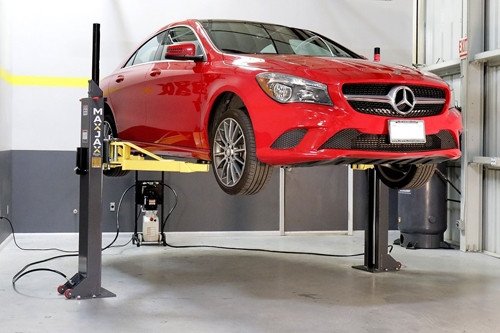
Lifts designed to be set up and taken down — or at least moved between locations. This category spans from the QuickJack (a low-rise frame system that stores on a shelf) to the MaxJax (a column-based portable 2-post alternative with drop-in anchors).
How It Works
QuickJack-style (low-rise): Two independent hydraulic frames slide under the vehicle. A hydraulic pump (powered by 12V, 110V, or 220V) raises both frames simultaneously via synchronized cylinders. The vehicle rises 21–24 inches on its frame rails. Frames weigh about 78 lbs each and store vertically against a wall or flat (3 inches) when not in use.
MaxJax-style (column): Two portable columns install into pre-drilled floor sockets using drop-in anchors. Swing arms extend from the columns like a traditional 2-post lift. When done, the columns lift out of the sockets and store against a wall. Setup takes roughly 15 minutes.
Key Specs Comparison
| Spec | QuickJack BL-5000SLX | QuickJack 6000TL | MaxJax M7K |
|---|---|---|---|
| Capacity | 5,000 lbs | 6,000 lbs | 7,000 lbs |
| Max rise | 21.3″ | 24″ | 47–51″ |
| Collapsed/stored height | 3″ / stores vertically | 3.5″ / stores vertically | Columns store against wall |
| Weight per unit | ~78 lbs per frame | ~78 lbs per frame | ~300 lbs per column |
| Power | 110V | 12V / 110V / 220V | 220V |
| Anchoring | None required | None required | Drop-in floor sockets |
| Price | ~$1,000–$1,500 | ~$1,900–$1,950 | ~$5,200 |
| ALI Certified | Yes | Yes | Yes |
Pros
- No permanent footprint — garage returns to full use when lift is stored
- Ideal for renters — QuickJack requires zero floor modification; MaxJax requires only small floor sockets
- Flexible placement — QuickJack can be used in a driveway; MaxJax can move between pre-drilled socket locations
- ALI certified — both QuickJack and MaxJax are independently safety-certified
- True portability — QuickJack stores flat, good resale value, 110V options available
- Lower entry point — QuickJack starts around $1,000–$1,950
Cons
- Limited rise height — QuickJack maxes at 24 inches (lying-down work only); MaxJax reaches 47–51 inches (standing, but not full 2-post height)
- Setup time — QuickJack takes 5–10 minutes per use; MaxJax takes 10–15 minutes to install columns
- Lower capacity ceiling — 5,000–7,000 lbs vs. 10,000–14,000 lbs for permanent lifts
- MaxJax is expensive for its capability — at $5,200, it approaches permanent 2-post lift prices with less capacity
- Must be positioned each use — no drive-on convenience like a 4-post
Who Should Buy a Portable Lift
Renters who can’t modify their garage permanently. Multi-use garages where the lift needs to disappear when not in use. Weekend mechanics who do oil changes, brake pads, and basic maintenance a few times a month. Also excellent as a travel lift — some mobile mechanics carry QuickJacks to client locations.
Not ideal if: You wrench frequently enough to justify a permanent lift (the setup/teardown time adds up), you need to lift heavy trucks, or you want full standing-height access.
Portable lift guide | QuickJack review | Full portable comparison
7. Single-Post Lifts
One column, one hydraulic cylinder, one platform arm or pair of arms. The smallest-footprint full-height lift available. Popular with car collectors who need to maximize parking density — stack two cars in a single bay using just one column’s worth of floor space.
How It Works
A single column bolts to the floor (and sometimes to the wall or ceiling for additional rigidity). A hydraulic cylinder raises a platform or swing arms that support the vehicle. The vehicle lifts to full height on one side, with 360-degree walk-around access — though the column itself occupies one side.
Key Specs
- Capacity: 4,500–6,500 lbs
- Max rise: 72–78 inches
- Concrete: 6 inches minimum at 3,000 PSI (the single-point load concentration demands thicker slabs)
- Power: 220V single-phase
- Footprint: Smallest of any full-height lift
Representative Models
| Model | Capacity | Max Height | Price Range |
|---|---|---|---|
| American Custom Lifts M-1 | 4,500–6,500 lbs | ~78″ | ~$3,500–$5,000 |
| IDEAL MSC-6KLP | 6,000 lbs | ~77″ | ~$5,600 |
| AMGO SL-6 | 6,000 lbs | 77″ | ~$3,500–$4,500 |
Pros
- Smallest footprint — one column instead of two or four
- 360-degree access — walk completely around the vehicle (except where the column stands)
- Parking density — stack two cars per bay with one column
- Clean aesthetics — popular in showrooms and high-end home garages
Cons
- Lower capacity — 4,500–6,500 lbs limits you to sedans, sports cars, and light SUVs; no trucks
- Less stable than 2-post or 4-post — single-point support concentrates all load on one column
- Thicker concrete required — 6 inches minimum due to concentrated anchor loads
- Not designed for heavy service work — the single-column design limits what you can do underneath safely
- Higher cost per pound of capacity — you’re paying $3,500–$5,600 for 6,000 lbs when a 2-post offers 10,000 lbs for the same price
- Limited model selection — far fewer manufacturers and options compared to 2-post and 4-post
Who Should Buy a Single-Post Lift
Car collectors with multiple vehicles and limited garage bays. Showroom and museum installations. High-end home garages where aesthetics matter and the primary use is storage and display, not heavy wrenching.
Not ideal if: You do regular maintenance work (2-post is more capable), you have heavy vehicles (capacity is limited), or your concrete is under 6 inches thick.
Browse single-post lifts
8. In-Ground Lifts
Installed in a vault below the floor surface. When retracted, the floor is completely flat — no columns, no runways, no obstructions. When activated, the lift platform rises from below grade to full service height.
Best for: High-end residential garages where aesthetics matter, commercial shops where floor space flexibility is critical, and any application where a completely clear floor is required.
Key Specs
- Capacity: 10,000–30,000 lbs
- Price: $5,000–$15,000+ for the lift, plus $3,000–$10,000+ for concrete vault construction
- Total installed cost: $8,000–$25,000+
- Ceiling needed: Any — no overhead structure required
Pros
- Floor is completely clear when retracted — invisible lift with maximum aesthetic appeal
- Full-rise service height — provides the same working height as a 2-post without any above-ground footprint
- No ceiling constraints — works in any ceiling height since the mechanism is underground
- High capacity options — models up to 30,000 lbs available for commercial applications
Cons
- Most expensive option by far — lift cost plus vault construction runs $8,000–$25,000+
- Requires significant construction — concrete vault, drainage, waterproofing must all be engineered
- Professional installation only — never a DIY project
- Maintenance access difficult — servicing the hydraulic system requires getting into the vault
- Impractical for existing garages — best suited for new construction where the vault can be planned into the foundation
9. Alignment Lifts
Specialized lifts with integrated turn plates and slip plates built into the runways, designed specifically for wheel alignment service. The turn plates allow the front wheels to rotate freely during alignment measurement, and the slip plates allow the rear wheels to move laterally.
Best for: Shops offering wheel alignment service. Not suitable for general repair — the turntables and slip plates make these lifts unsuitable for undercar work.
Capacity range: 10,000–14,000 lbs. Price range: $5,000–$15,000 (lift only; alignment machine is separate).
For alignment equipment pricing, see our wheel alignment machine cost guide.
10. Overhead / Platform Lifts
The newest category in the consumer car lift market. A platform raises the vehicle to ceiling height using a mechanism with no side posts — the vehicle goes straight up, and you park a second vehicle directly underneath. When lowered, the platform sits flush with the floor.
How It Works
A platform with integrated ramps sits at floor level. You drive onto it. Hydraulic cylinders (typically four, one at each corner) raise the platform straight up. The vehicle rises to within inches of the ceiling, creating full clearance below for a second vehicle or workspace. No columns, no overhead beams — the lifting mechanism is integrated into the platform edges or corners.
Key Specs
- Capacity: 6,000 lbs (current models)
- Max height: 80–85 inches of rise
- Overhead clearance: 80 inches at full rise
- Lowered height: Flush with floor
- Power: 208–240V single-phase
- Ceiling requirement: 9 feet minimum — fits standard residential garages
- Price: $12,000–$15,000
The BendPak Autostacker
The Autostacker A6S is the dominant product in this category. At 6,000 lbs capacity and $12,000–$15,000, it’s a premium investment. The A6W variant adds 8 inches of interior width for wider vehicles. A galvanized option is available for coastal environments where corrosion is a concern.
Pros
- Fits standard ceilings — designed for 9-foot residential garage ceilings, which no 2-post or 4-post lift can claim
- Zero side posts — no columns eating floor space
- Flush when lowered — completely invisible when not in use
- True double parking — full-size vehicle on top, full-size vehicle underneath
- Premium aesthetics — clean, modern design appropriate for high-end homes and condo garages
Cons
- Expensive — $12,000–$15,000 is 2–3x the price of a quality 2-post lift
- Not a service lift — the vehicle is at ceiling height, not working height; this is for parking and storage only
- 6,000 lb capacity — sedans, sports cars, and light SUVs only; no trucks
- Professional installation required — not a DIY project
- Limited model selection — essentially one manufacturer (BendPak/Autostacker) dominates this space
- Power requirement — 208–240V, so you may need electrical work
Who Should Buy an Overhead Lift
Condo and townhome owners with a single garage bay who need to park two cars. Homeowners with standard 9-foot ceilings who can’t fit a traditional lift. Anyone who values the aesthetics of an invisible lift system and has the budget for premium equipment.
Not ideal if: You want to work on cars (this is a parking lift, not a service lift), you need to lift trucks (6,000 lb limit), or you’re budget-conscious.
Read our overhead car lifts guide for the full breakdown.
11. Mobile Column Lifts
Four or more individual column lifts on casters that roll into position around the vehicle. Each column lifts independently via mechanical or hydraulic screw. Used almost exclusively in commercial settings for heavy vehicles — buses, trucks, RVs.
Best for: Commercial heavy vehicle service where permanently installed lifts aren’t practical. Capacity range: 12,000–72,000+ lbs (per set). Price range: $15,000–$60,000+ per set.
Not relevant for home garages, but included for completeness.
How to Choose: The Decision Framework
Forget about brands and models for a moment. Answer these four questions and the right car lift type becomes obvious:
Question 1: What’s your ceiling height?
| Ceiling Height | Compatible Car Lift Types |
|---|---|
| 8–9 feet | Scissor (mid-rise/low-rise), portable (QuickJack), overhead (Autostacker) |
| 9–10 feet | All above + low-profile 2-post (Triumph NT-9 at 111″) with limited rise |
| 10–11 feet | All above + more 2-post and 4-post options with careful vehicle/height matching |
| 11–12 feet | Most 2-post and 4-post models |
| 12+ feet | All lift types, full rise capability |
Plug your exact ceiling height into the fitment checker for precise model matching.
Question 2: What work are you doing?
| Work Type | Best Lift Type | Why |
|---|---|---|
| Oil changes, filters, basic maintenance | Scissor or portable | Quick access to underside at minimal cost |
| Brakes, wheels, tires | Scissor (mid-rise) or 4-post with bridge jacks | Waist-height access to wheel wells |
| Suspension, exhaust, drivetrain | 2-post | Full undercarriage access from any angle |
| Engine/transmission swaps | 2-post | Overhead clearance for removal |
| Full restorations | 2-post | Long-term access to every component |
| Storage and parking | 4-post, overhead, or single-post | Drive-on convenience and double stacking |
| Wheel alignment | Alignment lift | Integrated turn/slip plates |
| Clean-floor aesthetics | In-ground or overhead | Invisible when retracted |
Question 3: Is this permanent?
| Situation | Best Lift Type |
|---|---|
| Own the property, dedicated garage bay | 2-post or 4-post |
| Own the property, multi-use garage | Scissor (flush when lowered) or portable |
| Renting, can’t modify floors | Portable (QuickJack) |
| Shared/commercial space | Portable (MaxJax with floor sockets) |
| New construction, budget for vault | In-ground |
Question 4: What’s your budget?
| Budget | Best Option |
|---|---|
| Under $2,000 | QuickJack BL-5000SLX or 6000TL (portable scissor) |
| $2,000–$4,000 | Budget 2-post (Triumph NT-9) or mid-rise scissor (BendPak MD-6XP) |
| $4,000–$7,000 | Quality 2-post (Atlas PV-10PX, BendPak XPR-10AS) or 4-post (BendPak HD-9) |
| $7,000–$10,000 | Premium 4-post (BendPak HDS-14, Atlas 412) or full-rise scissor |
| $10,000+ | Overhead (Autostacker), in-ground, or commercial-grade models |
Total Cost: More Than the Sticker Price
The lift itself is 50–80% of your total investment. Here’s what else to budget for each type of car lift:
| Cost Item | Range | Notes |
|---|---|---|
| Lift (delivered) | $1,000–$15,000 | Depends on type and model |
| Professional installation | $400–$2,000 | Required for overhead and in-ground; recommended for all |
| Electrical work | $0–$800 | $0 if 110V model or existing 220V; $300–$800 to add 220V circuit |
| Concrete work | $0–$10,000+ | $0 if slab meets spec; up to $10,000+ for in-ground vault construction |
| Rolling bridge jacks (4-post only) | $500–$1,200 | Required for tire-off work on 4-post lifts |
| Truck adapters | $50–$200 | For lifting trucks on 2-post lifts; some models include them |
For concrete specifics, read our concrete requirements guide. For electrical planning, see our 110V vs. 220V car lift guide.
Decision Guide: If Your Goal Is X, Buy Type Y
| Your Primary Goal | Recommended Type | Why |
|---|---|---|
| Maintenance & repair work | 2-post | Full access, best for regular wrenching |
| Vehicle storage (stack cars) | 4-post storage or single-post | Drive-on stacking, minimal footprint |
| Storage AND occasional service | 4-post service + bridge jacks | Dual-purpose capability |
| Low ceiling garage (under 10′) | Mid-rise scissor or QuickJack | No ceiling constraints |
| Portable / rental garage | QuickJack | No installation, stores flat |
| Maximum aesthetic / clean floor | In-ground or overhead | Invisible when retracted |
| Standard 9-foot ceiling, double parking | Overhead (Autostacker) | Zero side posts, fits standard ceilings |
| Commercial alignment service | Alignment lift | Integrated turn/slip plates |
Your Next Step
Measure three things: your ceiling height, your available floor space, and your concrete thickness. Then use the fitment checker — input your garage dimensions and vehicle, and it returns every compatible lift from every type and brand.
If you already know which type of car lift you want, go deeper:
- 2-Post Garage Lifts: Complete Buyer’s Guide
- Best 4-Post Car Lifts
- Portable Car Lifts: QuickJack, MaxJax & Alternatives
- Overhead Car Lifts: What They Are & Who They’re For
- Scissor vs. 2-Post vs. 4-Post Lifts
- Mid-Rise Car Lift Guide
- Low-Ceiling Garage Guide
- Car Storage Lift Guide
Need installation help? Our installer directory connects you with certified lift technicians in your area.
Find the Right Car Lift for Your Garage
Use our free tools to check garage fitment, compare verified specs across 600+ models, and find a certified installer near you.
Frequently Asked Questions
What are the different types of car lifts?
There are nine main types of car lifts: 2-post (service), 4-post service, 4-post storage/parking, scissor low-rise, scissor mid-rise, single-post (compact parking), portable (QuickJack and MaxJax), in-ground (flush-floor), alignment (wheel alignment service), and overhead/platform (ceiling-height parking). Each type serves a specific use case — 2-post for repair work, 4-post for storage, scissor for low ceilings, portable for renters, in-ground for clean-floor aesthetics.
Which type of car lift is best for a home garage?
For most home mechanics, a 2-post lift offers the best combination of versatility, capacity, and value. It provides full undercarriage access for every type of maintenance and repair work. If your ceiling is under 10 feet, a mid-rise scissor lift or a low-profile 2-post model like the Triumph NT-9 (111″ overall height) is the better fit. If your primary goal is parking two cars in one bay, a 4-post lift or overhead platform is the right choice. Use our fitment checker to see which models work with your specific garage dimensions.
What’s the difference between a 2-post and 4-post lift?
A 2-post lift uses two columns with swing arms — you position the arms under the vehicle’s lift points, and the vehicle rises with all four wheels hanging free for full undercarriage access. A 4-post lift uses four columns with drive-on runways — you drive onto the lift like a ramp, making it simpler to use but blocking center undercarriage access. The 2-post is better for service work; the 4-post is better for storage and tire/brake jobs. 4-post lifts need bridge jacks ($500–$1,200) for wheel-off work. Read our full 2-post vs. 4-post comparison for the detailed breakdown.
What is the most popular type of car lift?
The 2-post lift is the most popular type for both home garages and commercial shops. It provides the best balance of undercar access, floor space usage, and price. The most common configuration is a 10,000 lb asymmetric 2-post lift — it handles nearly every passenger vehicle with door clearance for interior access.
How much does a car lift cost?
Portable scissor lifts (QuickJack) start around $1,000–$1,950. Budget 2-post lifts run $2,000–$3,600. Mid-range 2-post and 4-post lifts cost $4,500–$7,000. Premium 4-post lifts reach $8,000–$9,000. Overhead platform lifts are $12,000–$15,000. In-ground lifts run $5,000–$15,000+ for the unit, plus $3,000–$10,000+ for vault construction. Add $400–$2,000 for professional installation and $300–$800 for electrical work if you need a 220V circuit.
Can I install a car lift in a garage with 8-foot ceilings?
Yes, but your options are limited to scissor lifts (mid-rise and low-rise), portable lifts (QuickJack), and the BendPak Autostacker overhead platform (designed for 9-foot ceilings). Traditional 2-post and 4-post lifts require at least 10–12 feet of ceiling height. Read our low-ceiling garage guide for detailed solutions.
Do all car lifts need 220V power?
No. Portable lifts like the QuickJack operate on 12V (vehicle battery) or 110V household current. Some mid-rise scissor lifts like the BendPak MD-6XP run on 110V. The Triumph NT-9 2-post lift also operates on 110V. Most full-size 2-post lifts, 4-post lifts, and overhead lifts require 220V single-phase power. Adding a 220V circuit costs $300–$800 from a licensed electrician. See our 110V vs. 220V car lift guide for details.
What concrete thickness do I need for a car lift?
Most 2-post and 4-post lifts require a minimum of 4 inches of concrete at 3,000 PSI compressive strength for lifts rated up to 10,000 lbs. Lifts above 12,000 lbs and single-post lifts typically require 6 inches. Portable lifts like the QuickJack require no concrete work at all. In-ground lifts require full vault construction. See our concrete requirements guide for testing methods and remediation options.
Are car lifts safe for home use?
Yes — when properly installed on adequate concrete, connected to appropriate electrical supply, and used within their rated capacity. Look for ALI (Automotive Lift Institute) certification, which means the lift has been independently tested and verified. Both the BendPak XPR-10AS and MaxJax M7K carry ALI certification. Professional installation is recommended for safety verification and warranty compliance. Find certified installers in our installer directory.