
The answer
Half-ton trucks (F-150, Silverado 1500, RAM 1500) need at least 9,000 lbs — 10,000 lbs for full-size crew cabs.
Compiled by Car Lift Lab from verified manufacturer specifications across 600+ car lift models.
Key Takeaways
- Half-ton trucks (F-150, Silverado 1500, RAM 1500): Need a minimum 9,000 lb lift. A 10,000 lb lift is recommended for full-size crew cab configurations.
- Three-quarter and one-ton trucks (F-250/350, 2500/3500): Need a minimum 10,000 lb lift. A 12,000–14,000 lb lift is strongly recommended.
- Ceiling clearance is the hidden problem. A lifted truck on a 2-post lift may exceed your ceiling height. A stock F-150 is 77–79″ tall — on a lift with 69″ of rise, the top of the truck is at ~148″ (12’4″). Add a leveling kit or aftermarket bumper and you’re pushing 13 feet.
- Arm reach matters for trucks. Truck frame rails are wider-spaced than car subframes. Verify the lift’s arm reach covers your truck’s frame width. Extended-reach arms or truck adapter pads may be needed.
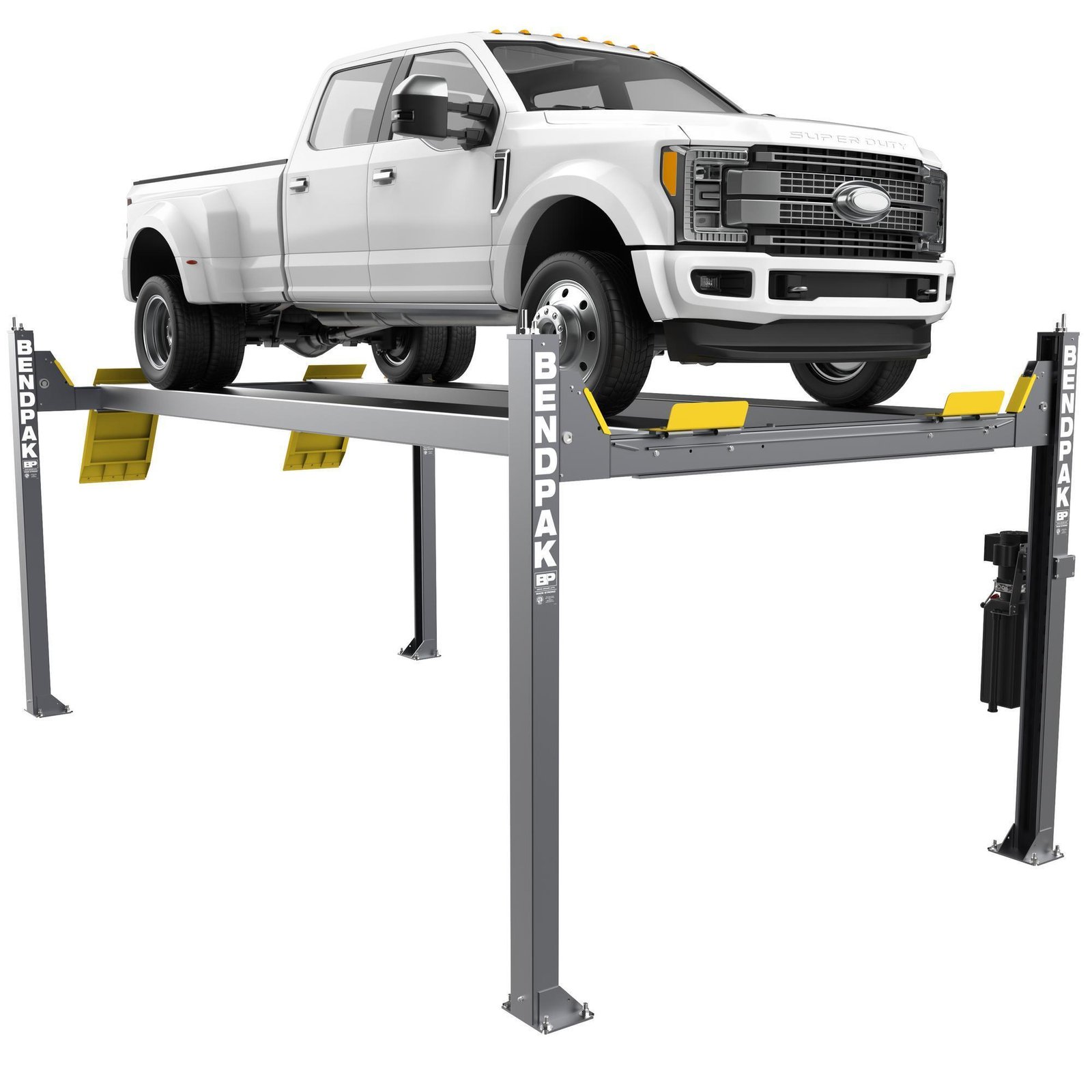
- 4-post lifts are the simplest solution for trucks. Drive on, drive off — no arm positioning, no frame-finding, no adapters needed in most cases.
- Use the fitment checker to match your specific truck to compatible lifts.
Trucks are the hardest vehicles to lift at home. They’re heavier than sedans (often by 2,000+ lbs), taller (reducing your usable ceiling clearance), wider (tighter fit between columns), and longer (requiring more arm reach and runway length). A lift that works perfectly for a Camry may not have enough capacity, reach, or clearance for your F-150.
This guide covers truck-specific lift requirements — weight, clearance, arm reach, adapter pads — and the specific models that handle trucks best at each capacity tier.
Truck Weights: The Capacity Question
Half-Ton Trucks (1500 Series)
| Vehicle | Curb Weight Range | Minimum Lift | Recommended Lift |
|---|---|---|---|
| Ford F-150 (regular cab, 2WD) | 4,069–4,700 lbs | 7,000 lbs | 9,000 lbs |
| Ford F-150 (crew cab, 4WD) | 5,000–5,700 lbs | 9,000 lbs | 10,000 lbs |
| Chevy Silverado 1500 (regular cab) | 4,400–4,800 lbs | 7,000 lbs | 9,000 lbs |
| Chevy Silverado 1500 (crew cab, 4WD) | 4,900–5,300 lbs | 9,000 lbs | 10,000 lbs |
| RAM 1500 (quad cab) | 4,800–5,100 lbs | 9,000 lbs | 10,000 lbs |
| RAM 1500 (crew cab, 4WD) | 5,100–5,600 lbs | 9,000 lbs | 10,000 lbs |
| Toyota Tundra (crew cab) | 5,200–5,700 lbs | 9,000 lbs | 10,000 lbs |
A base-model half-ton truck fits comfortably on a 9,000 lb lift. A fully loaded crew cab with 4WD, the heavy engine option, and aftermarket accessories pushes toward the upper end — and a 10,000 lb lift provides the recommended 20% capacity margin.
Three-Quarter Ton Trucks (2500 Series)
| Vehicle | Curb Weight Range | Minimum Lift | Recommended Lift |
|---|---|---|---|
| Ford F-250 (crew cab, 4WD, gas) | 6,500–7,000 lbs | 10,000 lbs | 12,000 lbs |
| Ford F-250 (crew cab, 4WD, diesel) | 7,200–7,700 lbs | 10,000 lbs | 12,000 lbs |
| Chevy Silverado 2500HD (crew cab, 4WD) | 6,500–7,500 lbs | 10,000 lbs | 12,000 lbs |
| RAM 2500 (crew cab, 4WD, diesel) | 7,000–7,400 lbs | 10,000 lbs | 12,000 lbs |
One-Ton Trucks (3500 Series)
| Vehicle | Curb Weight Range | Minimum Lift | Recommended Lift |
|---|---|---|---|
| Ford F-350 (crew cab, 4WD, diesel) | 7,500–8,500 lbs | 12,000 lbs | 14,000 lbs |
| Chevy Silverado 3500HD (crew cab, 4WD, dually) | 7,500–8,200 lbs | 12,000 lbs | 14,000 lbs |
| RAM 3500 (crew cab, 4WD, diesel, dually) | 7,800–8,600 lbs | 12,000 lbs | 14,000 lbs |
For a detailed capacity sizing walkthrough with the 20% rule, see the car lift size guide.
Full-Size SUVs
| Vehicle | Curb Weight Range | Minimum Lift | Recommended Lift |
|---|---|---|---|
| Chevy Tahoe | 5,400–5,800 lbs | 9,000 lbs | 10,000 lbs |
| Chevy Suburban | 5,600–6,000 lbs | 9,000 lbs | 10,000 lbs |
| Ford Expedition | 5,400–5,900 lbs | 9,000 lbs | 10,000 lbs |
| Toyota 4Runner | 4,400–4,700 lbs | 7,000 lbs | 9,000 lbs |
| Jeep Wrangler Unlimited | 4,400–4,800 lbs | 7,000 lbs | 9,000 lbs |
Ceiling Clearance: The Hidden Constraint
Trucks are tall. When you add vehicle height to lift rise, the total can exceed your ceiling. Here’s the math:
Total height at full rise = lift rise height + vehicle height + pad adapter height
| Vehicle | Approx. Height (stock) | On a 69″ rise lift | On a 75″ rise lift |
|---|---|---|---|
| Ford F-150 (stock) | 77″ (6’5″) | 146″ (12’2″) | 152″ (12’8″) |
| F-150 with 2″ level | 79″ (6’7″) | 148″ (12’4″) | 154″ (12’10”) |
| F-150 with 6″ lift kit | 83″ (6’11”) | 152″ (12’8″) | 158″ (13’2″) |
| Chevy Silverado 1500 | 76″ (6’4″) | 145″ (12’1″) | 151″ (12’7″) |
| Ford F-250 | 80″ (6’8″) | 149″ (12’5″) | 155″ (12’11”) |
| RAM 2500 | 79″ (6’7″) | 148″ (12’4″) | 154″ (12’10”) |
What this means: A stock F-150 on a standard 2-post lift (69″ rise, 145″ overall height) puts the truck roof at about 12’2″ — and that’s before the lift reaches the top of its columns. In a garage with a 12-foot ceiling, the truck contacts the ceiling before you reach full working height. You’ll be limited to partial rise, which may not give you enough clearance to work underneath.
Solutions:
- Choose a lift with adjustable height. The Atlas PV-10PX has adjustable column height (143″ or 147″).
- Accept partial rise. Many truck owners work at 4–5 feet of rise instead of full height.
- Use a 4-post lift. 4-post lifts are shorter overall — the BendPak HD-9 columns are about 100″ tall, and the runways add only 4.5″ to vehicle height. Your truck sits much lower relative to the ceiling.
- Use a mid-rise or portable lift. The BendPak MD-6XP gives 48″ of rise with zero ceiling impact. QuickJack provides 24″ of rise — enough for oil changes, brake jobs, and exhaust work.
Arm Reach and Frame Access
The Truck Arm Reach Problem
Trucks sit higher than cars. Their frame rails are 15–25 inches off the ground — significantly higher than a sedan’s subframe or pinch weld (typically 6–12 inches). On a 2-post lift, the arm pads must reach up to the frame rail height while the arm shaft clears everything below.
Most standard 2-post lift arms handle this fine for half-ton trucks. For heavy-duty trucks (F-250+) with higher frames and larger tires, verify:
- Arm telescoping range covers your truck’s frame height with the pads
- Arm shaft clears the truck’s body panels, running boards, exhaust, and fuel tank at full extension
- Front arm reach extends far enough forward to contact the front frame rail behind the lower control arm
Truck Adapter Pads
If the standard lift pads don’t reach your truck’s frame rails at the correct height, truck adapter pads solve the problem.
What they are: Stackable polyurethane or rubber blocks that sit on top of the standard arm pads, adding 2–6 inches of height. They bring the pad contact point up to frame rail level without over-extending the arm.
When you need them:
- Heavy-duty trucks (F-250+) with high frame rails
- Lifted trucks with aftermarket suspension
- Any truck where the standard pad height doesn’t match the frame rail height
Cost: $50–$150 for a set of 4 adapters. Many lifts (BendPak XPR series, Atlas PV-10PX) include truck adapters or offer them as bundled accessories. The BendPak MD-6XP includes a truck adapter set as standard equipment.
Best Lifts for Trucks by Category
2-Post Lifts for Trucks
| Model | Capacity | Best For | Rise | Price |
|---|---|---|---|---|
| Triumph NT-9 | 9,000 lbs | Half-tons on 110V | 72″ | ~$3,200–$3,600 |
| Atlas PV-10PX | 10,000 lbs | Half-tons + light HD | 72″ | ~$4,500–$4,700 |
| BendPak XPR-10AS | 10,000 lbs | Half-tons (premium) | 69″ | ~$5,800–$6,100 |
| BendPak XPR-10S | 10,000 lbs | Half-tons + longer trucks (symmetric) | 69″ | ~$5,600–$5,900 |
| BendPak XPR-12CL | 12,000 lbs | 2500/3500 trucks | 69″ | ~$7,500–$8,500 |
| Atlas PV-12PX | 12,000 lbs | 2500/3500 trucks (value) | ~72″ | ~$5,000–$6,000 |
Truck-specific notes:
- The BendPak XPR-10S (symmetric) positions the truck’s center of gravity directly between the columns — better for trucks than asymmetric designs where the heavier front axle is ahead of the columns. See the symmetric vs asymmetric guide for details.
- The XPR-12CL has 120″ inside column width — enough for dually trucks. Its 106″ drive-through clearance accommodates the widest trucks.
- The Triumph NT-9 is the only option for truck owners who need 110V power, but at 9,000 lbs it’s limited to lighter half-ton configurations.
4-Post Lifts for Trucks
| Model | Capacity | Best For | Runway Length | Price |
|---|---|---|---|---|
| Triumph NSS-8 | 8,000 lbs | Light half-tons, storage | 165″ | ~$3,200–$4,000 |
| Wildfire XLT | 9,000 lbs | Half-tons, best value | 190″ | ~$5,395 |
| Atlas Garage Pro 9000 | 9,000 lbs | Half-tons, portable | 227″ (overall) | ~$5,700–$6,000 |
| BendPak HD-9XL | 9,000 lbs | Long-wheelbase trucks | ~186″ | ~$5,200–$6,000 |
| Atlas 412 | 12,000 lbs | 2500/3500 trucks | 236″ (overall) | ~$7,600 |
| BendPak HDS-14 | 14,000 lbs | Any truck, commercial | ~203″ | ~$8,300–$8,600 |
| Wildfire Truck | 12,000 lbs | Heavy trucks, 220V | Extended | ~$9,195 |
Why 4-post lifts are often better for trucks:
- No arm positioning required — drive on and lift
- No need to find frame rails or worry about adapter pad height
- Suspension stays in its natural position (useful for suspension work measurements)
- Lower overall height means more ceiling clearance
- Storage capability between uses
Truck-specific notes:
- Runway length matters. A crew cab long bed F-150 has a wheelbase around 163″. Standard 165″ runways barely fit. The Wildfire XLT (190″) and Atlas Garage Pro 9000 (227″ overall) accommodate the longest trucks.
- The BendPak HD-9XL is the extended-length version of the HD-9, specifically designed for long-wheelbase trucks and SUVs.
- The Wildfire Truck is a 12,000 lb model with extended runways built specifically for heavy truck use.
Portable Lifts for Trucks
| Model | Capacity | Best For | Rise | Price |
|---|---|---|---|---|
| QuickJack 7000TL/TLX | 7,000 lbs | Light trucks, quick jobs | 24.5″ | ~$2,000–$2,200 |
| QuickJack 8000TL/TLX | 8,000 lbs | Half-tons | 24.5″ | ~$2,100–$2,250 |
| MaxJax M7K | 7,000 lbs | Half-tons, more height | 47–50″ | ~$5,200 |
Portable lift limitations with trucks:
- QuickJack provides only 24″ of rise — enough for oil changes and brake work, but not full access to the undercarriage
- QuickJack’s frame length (70–76″) may not span the full distance between lift points on long-wheelbase trucks — check fitment
- The 8000TLX (extended) model adds 6″ of frame length and is the better choice for trucks
- MaxJax provides much more height (~50″) but requires floor anchoring and 220V power
Common Truck Lifting Mistakes
Using the Wrong Lift Points
Trucks are body-on-frame vehicles. The lift points are on the frame rails — not the body, not the running boards, not the exhaust, and not the oil pan. The frame rails are the heavy steel members running the length of the vehicle under the body. Position the front arms under the front frame rails (behind the lower control arm mounts) and the rear arms under the rear frame rails (ahead of the rear axle or leaf spring mounts). See the positioning guide for detailed instructions.
Ignoring Aftermarket Weight
Aftermarket additions increase your truck’s weight beyond factory curb weight:
- Steel bumper: +100–200 lbs
- Winch: +50–100 lbs
- Bed rack + roof rack: +100–200 lbs
- Toolbox: +50–100 lbs
- Lift kit hardware: +30–80 lbs
- Larger tires/wheels: +40–100 lbs
A fully accessorized truck can weigh 400–800 lbs more than factory curb weight. Factor this into your capacity calculation.
Forgetting Ceiling Height
The most common truck-related lift mistake. Measure your ceiling, measure your truck, add lift rise height, and do the math before buying. See the ceiling clearance section above.
Related Guides
Find the Right Lift for Your Garage
Use our free tools to check garage fitment, compare verified specs, and find a certified installer near you.
Frequently Asked Questions
What size lift do I need for an F-150?
A 9,000 lb lift handles most F-150 configurations with adequate margin. The heaviest F-150s (crew cab, long bed, 4WD, 5.0L V8) weigh up to 5,700 lbs — that’s 63% of a 9,000 lb lift’s capacity. For maximum margin and future-proofing, a 10,000 lb lift is the best choice. See the size guide for the full capacity calculation.
Can a 9,000 lb lift handle a Silverado 2500?
Technically, a lightweight Silverado 2500 (6,500 lbs) is at 72% of a 9,000 lb lift’s capacity — within safe limits. But the heavier configurations (crew cab, diesel, 4WD at 7,500 lbs) push to 83% — uncomfortably close to the 80% recommended maximum. A 10,000 or 12,000 lb lift is the safer and recommended choice for 2500-series trucks.
Do I need a symmetric or asymmetric lift for my truck?
Either works, but symmetric lifts position the truck’s weight more evenly between the columns — which is advantageous for heavy trucks. Asymmetric lifts work fine for half-tons but shift more weight forward of the columns on heavy trucks. For 2500/3500 trucks, symmetric is generally preferred. See the symmetric vs asymmetric guide.
What's the best lift for a dually truck?
Dually trucks are wider than standard trucks. Verify the lift’s drive-through width (distance between columns on a 2-post lift, or between posts on a 4-post lift). The BendPak XPR-12CL has 106″ of drive-through clearance. The Atlas 414 has 102″ between columns — the widest in the 4-post class. The fitment checker verifies width compatibility for your specific truck.
Can I use a QuickJack on my truck?
Yes — the QuickJack 7000TL/TLX and 8000TL/TLX handle most half-ton trucks by capacity. The limitation is rise height (24.5″) and frame length (70–76″). You get enough clearance for oil changes, brake pad replacement, and exhaust inspection, but not full undercarriage access. Use the 8000TLX (extended model) for the best fit on trucks, and verify your truck’s lift point spacing fits within the frame length.