
Portable & Inflatable Paint Booths: Buyer’s Guide [2026]
A paint booth is the difference between a dusty, orange-peeled respray and a finish that looks like it came out of a body shop. If you spray cars, motorcycles, furniture, or parts at home, a portable or inflatable paint booth gives you a filtered, enclosed, well-lit space without the cost of a permanent installation. This guide compares the real options — inflatable booths, collapsible pop-up tents, and DIY builds — and walks through the sizing, airflow, filtration, and safety details that actually determine finish quality.
In This Article
The good news: you no longer need a dedicated shop bay and a five-figure budget to get a clean finish. The portable paint booth market has matured, and inflatable booths in particular have made professional-style painting accessible in a home garage or driveway. Let’s break down what to buy and how to use it.
Why Use a Paint Booth?
Spraying in the open — in your driveway or an open garage — creates three problems that a booth solves:
- Dust and debris. Airborne dust lands on wet paint and cures into the finish as nibs and specks. A booth with filtered intake air dramatically reduces contamination.
- Overspray. Uncontained overspray drifts onto cars, walls, and neighbors’ property. A booth captures it in exhaust filters.
- Fumes. Solvent vapors are flammable and toxic. A booth’s directional airflow pulls fumes away from you and vents them safely.
The result is a cleaner, safer, more repeatable finish. Even a modest booth is a night-and-day improvement over spraying in the open, and the better ones rival small professional shops for hobby-grade work.
Quick Verdict
For most home users painting a full car, an inflatable paint booth (26-33 ft) with built-in intake/exhaust fans and filters is the best blend of finish quality, price, and convenience. For parts and small projects, a pop-up spray tent or a DIY plastic-and-fan enclosure is plenty. Whatever you choose, airflow and filtration — not the walls — are what make or break the finish.
Types of Portable Paint Booths
Portable booths fall into three broad categories, each suited to a different budget and project size.
1. Inflatable Paint Booths
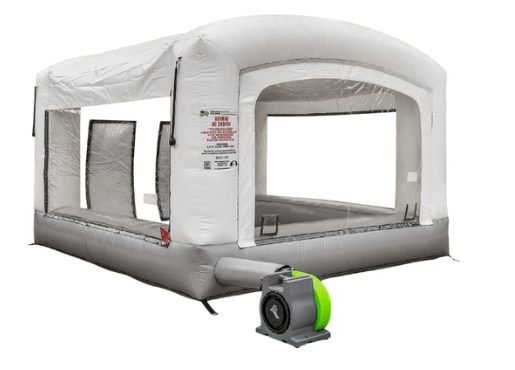
Air-frame tents kept rigid by a continuously running blower. Most include integrated intake and exhaust fans with filters. They inflate in minutes, enclose a genuine filtered space, and deflate for storage. This is the sweet spot for painting whole vehicles at home.
2. Collapsible Frame Booths (Pop-Up Tents)
A fabric-and-mesh enclosure over a folding metal or fiberglass frame, similar to a large canopy tent with zippered doors. Smaller versions are excellent spray tents for parts and furniture; larger ones can enclose a motorcycle or compact project. Cheaper than inflatables but usually rely on your own fans for airflow.
3. DIY Booths
A frame of PVC pipe, wood, or an existing garage bay, wrapped in plastic sheeting, with a filtered box-fan exhaust and a filtered intake. The lowest-cost option and infinitely customizable, but the finish quality depends entirely on how well you manage airflow, filtration, and lighting.
Paint Booth Comparison
Here is how representative real-world options compare across the categories. Prices fluctuate, so treat them as approximate ranges.
| Model / Type | Size Class | Key Feature | Approx. Price | Best For |
|---|---|---|---|---|
| Homeright Small Spray Shelter | Pop-up tent, ~5 ft | Folds flat, great for parts | ~$60-$90 | Small parts, furniture, crafts |
| Wagner Studio Spray Tent | Pop-up tent, ~6-9 ft | Turntable options, easy setup | ~$90-$200 | Furniture, wheels, medium parts |
| Sewinfla Inflatable Booth (13 ft) | Inflatable, ~13 ft | Blower + filters, motorcycle-size | ~$700-$1,000 | Motorcycles, small projects |
| Sewinfla Inflatable Booth (26 ft) | Inflatable, ~26 ft | Dual fans, full filtration | ~$1,300-$2,000 | Full-size cars |
| Sewinfla Inflatable Booth (33 ft) | Inflatable, ~33 ft | Walk-around room, big airflow | ~$2,000-$3,500 | Trucks, SUVs, larger vehicles |
| OrionMotorTech Inflatable Booth | Inflatable, ~26-33 ft | Value-priced with fans/filters | ~$1,200-$2,800 | Budget full-car painting |
| DIY PVC + Plastic + Box Fan | Custom, any size | Cheapest, fully customizable | ~$100-$400 | Hands-on hobbyists on a budget |
Note that inflatable-booth prices usually include the blower/inflation fan plus intake and exhaust fans and a starter set of filters — that bundled airflow gear is a big part of why they outperform a bare tent.
Sizing Your Paint Booth
The most common mistake is buying a booth that is just barely big enough for the object. You need walking room to get around the piece, and you need clearance for airflow to move across the surface evenly. Tight booths lead to uneven finish, touched panels, and poor overspray clearing.
| What You’re Painting | Minimum Booth (L x W x H) | Comfortable Booth |
|---|---|---|
| Parts, wheels, small furniture | 5 x 5 x 6 ft | 6 x 6 x 7 ft |
| Motorcycle / large furniture | 13 x 8 x 7 ft | 16 x 9 x 8 ft |
| Compact car | 23 x 13 x 8 ft | 26 x 15 x 9 ft |
| Full-size sedan / crossover | 26 x 15 x 9 ft | 30 x 16 x 9 ft |
| Truck / large SUV | 30 x 16 x 9 ft | 33 x 17 x 10 ft |
Add at least 3 feet of walking room around the vehicle and enough overhead height to spray the roof comfortably. Also confirm the booth fits your garage: check ceiling height and door width, and remember an inflatable booth needs its blower running the whole time, so account for the noise and the continuous airflow.
Airflow & Filtration Explained
Airflow is the single most important factor in finish quality — more than the booth material or price. There are two things to get right: the direction of airflow and the filtration on both ends.
Intake and Exhaust
A proper booth pulls clean, filtered air in one side and exhausts contaminated air (fumes and overspray) out the other, creating a steady one-directional flow across the object. The intake filter keeps dust out of the incoming air; the exhaust filter traps paint particles before they vent outside. Without both, you either get dust in your finish (no intake filter) or overspray drifting everywhere (no exhaust filter).
Cross-Draft vs. Downdraft
Portable booths are almost always cross-draft: air moves horizontally from one end to the other. Commercial booths are often downdraft: air comes from the ceiling and exits through the floor, which sweeps overspray straight down and away from the just-painted surface. Downdraft gives the cleanest results but requires a pit or elaborate floor plenum, which is impractical for portable use. Cross-draft is perfectly good for hobby work as long as you spray in the direction of the airflow.
Filter tip: Keep spare intake and exhaust filters on hand and change them on schedule. A clogged exhaust filter chokes airflow, traps fumes, and lets overspray settle back onto your finish. Filters are cheap; a ruined paint job is not.
Lighting
You cannot lay down an even coat if you cannot see the surface clearly. Good booths include or accommodate bright, even LED lighting positioned to reveal texture and coverage without hot spots. If you DIY, over-light it: cheap LED shop lights on the walls and ceiling make a huge difference in catching runs, dry spots, and missed areas while the paint is still workable.
Inflatable Paint Booths in Depth
Inflatable booths have become the default recommendation for home car painters, and for good reason. Here is the honest breakdown.
Inflatable Booth Pros
- Sets up and tears down in minutes
- Includes intake & exhaust fans + filters
- Genuinely enclosed, filtered space
- Packs away small when not in use
- Far better finish than open spraying
Inflatable Booth Cons
- Blower must run continuously
- Fabric can puncture; patch kits needed
- Not as durable as a permanent booth
- Airflow trails a true downdraft booth
- Needs floor space to inflate fully
In practice, an inflatable booth from a maker like Sewinfla or OrionMotorTech gives a hobbyist 80-90% of the practical benefit of a commercial cross-draft booth at a fraction of the cost. The keys to good results are running the fans long enough to establish steady airflow before you spray, keeping the filters fresh, and blowing/tacking the interior down to knock out dust before you start. Treat the fabric gently, patch punctures promptly, and let the booth dry fully before folding it to prevent mildew.
Building a DIY Paint Booth
If you are handy and budget-focused, a DIY booth is a legitimate path. The basic recipe:
- Frame. PVC pipe, 2×4 lumber, or an existing garage bay. PVC is cheap, light, and reusable.
- Walls. 4-6 mil plastic sheeting, sealed at the seams with tape. Keep it taut to reduce billowing that stirs up dust.
- Exhaust. A box fan (or a proper explosion-proof fan for solvent-heavy work) fitted with furnace filters, venting outdoors. This pulls fumes and overspray out.
- Intake. A filtered opening opposite the exhaust so clean air feeds the airflow. Cheap furnace filters over an intake port work well.
- Lighting. Multiple LED shop lights on the walls and ceiling for even, shadow-free coverage.
The two things people skimp on — filtered intake and adequate lighting — are exactly the two things that separate a good DIY finish from a dusty, patchy one. Do not skip them.
Fan safety note: Standard household box fans have non-sealed motors that can ignite solvent vapors. For occasional water-based or low-solvent work, hobbyists use them with the motor positioned outside the airstream. For solvent-based automotive paints and clearcoats, use a fan rated for the environment and keep all ignition sources well clear. When in doubt, err toward safer equipment.
Compressor & Spray Gun Notes
A booth is only half the equation — you also need enough air to run your spray gun. Most HVLP automotive spray guns need a steady supply of clean, dry air at a specific CFM and pressure. Undersizing your compressor causes the gun to sputter and lay down an inconsistent coat, which no booth can fix.
- CFM matters more than tank size. Check your gun’s required CFM at its operating PSI and make sure your compressor can sustain it, not just hit it briefly.
- Air must be clean and dry. Water and oil in the air line cause fisheyes and blemishes. Use a water separator and, for critical work, a desiccant dryer.
- Regulate at the gun. A regulator at the gun inlet gives you consistent pressure regardless of tank fluctuations.
If you are still building out your shop’s air supply, our dedicated air compressor guide covers sizing for paint and other garage tools in detail.
Paint Booth Safety
Automotive painting involves flammable solvents and toxic isocyanates in many clearcoats. Take safety seriously:
- Respirator. Wear a properly fitted respirator rated for organic vapors — not a dust mask. For catalyzed clearcoats containing isocyanates, a supplied-air respirator is the recommended standard.
- Ventilation. Never spray in an unventilated enclosed space. Confirm airflow is running before and throughout spraying and cleanup.
- Ignition sources. Keep pilot lights, space heaters, grinders, and electrical sparks away from the booth. Solvent vapor is heavier than air and can travel along the floor to an ignition source.
- Fire extinguisher. Keep a suitable extinguisher within reach.
- Skin & eyes. Wear a spray suit, gloves, and eye protection to avoid skin absorption and irritation.
Also check local codes: some jurisdictions regulate spraying and require specific ventilation or permits for anything beyond incidental hobby work. When in doubt, consult your local fire marshal.
Our Picks by Use Case
Best for Painting a Whole Car at Home
A 26-33 ft inflatable booth (e.g., Sewinfla or OrionMotorTech) with dual fans and filters. It gives you a filtered, walk-around space that sets up fast and stores small — the best blend of finish quality and value for a home garage. If you are also outfitting your garage with a lift so you can prep and paint lower panels and rockers comfortably, a portable car lift pairs well with a portable booth for a flexible, packable shop.
Best for Motorcycles & Mid-Size Projects
A ~13 ft inflatable booth or a large collapsible tent. Enough room to walk around a bike or a piece of furniture with proper airflow, without committing to a full car-size footprint.
Best for Parts, Wheels & Small Work
A pop-up spray shelter like the Homeright or Wagner tents. Cheap, folds flat, and turns a corner of the garage into a dust-controlled spray area in seconds.
Best for Budget / Tinkerers
A DIY PVC-and-plastic booth with a filtered box-fan exhaust, filtered intake, and plenty of LED lighting. The lowest cost path to a clean finish if you are willing to build it right.
Our Take
For the money, an inflatable paint booth is the best portable option for home car painting — it bundles the enclosure, fans, and filters that actually control finish quality. Match the size to your largest project with room to spare, keep fresh filters in it, run the airflow before you spray, and wear a real respirator. Do that, and a portable booth in your garage can produce a finish you will be proud of.
Frequently Asked Questions
What is the best portable paint booth for cars?
For full-size cars, an inflatable booth in the 26-33 ft range with integrated intake/exhaust fans and filters is the most practical portable option. Brands like Sewinfla and OrionMotorTech give you a filtered, enclosed space that sets up in minutes and packs away when done. For parts and smaller projects, a collapsible spray tent or a DIY enclosure works well.
How much does a paint booth cost?
A small pop-up spray tent runs about $60-$200. A motorcycle-size inflatable booth is roughly $700-$1,000, a full-car inflatable about $1,300-$2,000, and a truck-size booth $2,000-$3,500. Permanent commercial downdraft booths are a separate category at $10,000-$50,000-plus installed. Prices fluctuate, so treat these as approximate ranges.
Can you build a DIY paint booth in a garage?
Yes. Many hobbyists build a temporary booth with a PVC or wood frame wrapped in plastic sheeting, a box fan fitted with furnace filters for exhaust, and a separate filtered intake. The keys are directional airflow to control overspray, filtered intake to reduce dust, plenty of lighting, and safe exhaust of fumes away from ignition sources.
Do you need ventilation in a paint booth?
Yes, always. Automotive paints release flammable, toxic solvent vapors, and overspray must be carried away from you and any ignition source. A proper booth uses a filtered intake fan for clean air and a filtered exhaust fan to pull fumes and overspray out. Never spray in an unventilated space, and always wear a respirator rated for organic vapors.
What size paint booth do I need for a car?
For a full-size sedan or crossover, aim for at least about 26 ft long, 15 ft wide, and 9 ft tall so you can walk around the vehicle with room for airflow. Compact cars fit slightly smaller booths; trucks and large SUVs need a 33-ft-class booth. Always add a few feet beyond the vehicle footprint for walking space and airflow.
Are inflatable paint booths any good?
Yes — they are surprisingly capable for hobbyists and small shops. They set up in minutes, include intake/exhaust fans with filters, and create a genuinely enclosed, filtered environment. They will not match a permanent downdraft booth for airflow or durability, and the blower must run continuously, but for occasional home painting they are one of the best value options available.