


Car Lifts for Low Ceiling Garages: Complete Guide for 8-10 Foot Ceilings
The biggest myth in the car world is that you need a massive, warehouse-style garage to own a lift.
Every day, homeowners with standard 8-foot or 9-foot ceilings are told “No” by forums and friends. They give up on their dream of a 4-post lift, assuming they are stuck with a single parking spot forever.
They are wrong.
The truth is, you can stack two cars in a standard residential garage—if you know the math. It requires careful vehicle selection, a specific type of lift, and usually a “High-Lift” garage door modification.
In this guide, we will walk you through the exact formula to check your clearance and show you the “Hood Swap” trick that can magically create 6 inches of extra space.
The “3-Number” Formula: Do You Have Enough Height?
You don’t need to guess, and you don’t need a degree in engineering. To find out if a 4-post lift fits in your specific garage, you just need to add three numbers together.
Grab a tape measure and your car’s specs, then plug them into this formula:
(Height of Bottom Car) + (Height of Top Car) + 8 Inches = Minimum Ceiling Height
Where does the “8 Inches” come from?
It isn’t random. It accounts for the physics of the lift:
The thickness of the lift deck (the ramp the top car sits on).
The safety locks (you need to raise the lift past the lock to set it down).
A safety buffer for ceiling clearance.
Real-World Example: The “Sports Car Stack”
Let’s say you want to store a Porsche 911 over a Corvette C8.
Step 1
Corvette C8 (Bottom): 48 inches
Step 2
Porsche 911 (Top): 51 inches
Formula
Porsche 911 (Top): 51 inches
The Result: 107 inches is 8 feet, 11 inches.
Quick Reference: Common Car Heights
(Measurements are for stock suspension)
Vehicle Class | Popular Models | Approx. Height | Safe Stack Height* |
|---|---|---|---|
Supercars | Lamborghini Huracán McLaren 720S Ferrari F8 / 488 | 46″ 47″ 48″ | ~100″ (8.3 ft) ~101″ (8.4 ft) ~102″ (8.5 ft) |
Sports Cars | Chev. Corvette C8 Porsche 911 (992) Toyota Supra | 49″ 51″ 51″ | ~103″ (8.6 ft) ~105″ (8.75 ft) ~105″ (8.75 ft) |
Sedans/Muscle | BMW M3 / M4 Ford Mustang Tesla Model 3 | 56″ 55″ 57″ | ~110″ (9.1 ft) ~109″ (9.0 ft) ~111″ (9.2 ft) |
SUVs (Bottom Only) | BMW X5 Ford F-150 | 69″ 76″ | Cannot Stack Cannot Stack |
* Safe Stack Height = (Car Height) + (50″ Bottom Car Avg) + (4″ Deck) + (2″ Safety). This assumes you are parking a low sports car underneath.
The “Hood-Swap” Strategy (How to Cheat the Height)
If you ran the numbers above and came up 2 inches short, don’t worry. You can cheat.
Most cars are wedge-shaped. The roof is the highest point, but the hood is significantly lower. If you park both cars facing forward, you are stacking “Roof under Roof,” which wastes the most space.
The Solution: Back the top car onto the lift.
Your Garage Door is the Real Enemy (And How to Fix It)
In a standard home, when you open the garage door, it rolls back on tracks that hang right in the middle of your ceiling space. This creates an “artificial ceiling” that is often only 7 feet high, even if your actual ceiling is 9 feet.
To fit a lift, you must clear this obstruction. You need two specific upgrades:
Upgrade 1
High-Lift Track Conversion (~$400 – $600)
This modifies your tracks so the door travels up the wall as high as possible (hugging the ceiling) before it turns back. This instantly reclaims 12–24 inches of vertical space above your cars.
Upgrade 2
Wall-Mount “Jackshaft” Opener (~$500)
Standard garage openers hang in the center of the ceiling on a long rail. That rail will block your lift. A “Jackshaft” opener (like the LiftMaster 8500) mounts on the wall beside the door, eliminating the center rail entirely.
The Bottom Line:
You usually cannot install a 4-post lift without modifying your garage door tracks first.
The Best Lifts for Low Ceilings
Winner
The 4-Post Lift (Storage)
If your goal is parking two cars, this is your only real option. Look for “Low Profile” models like the BendPak HD-9, which offers multiple locking positions. This allows you to set the lift height exactly where you need it, rather than being stuck with fixed intervals.
Runner Up
The MaxJax (Repair Only)
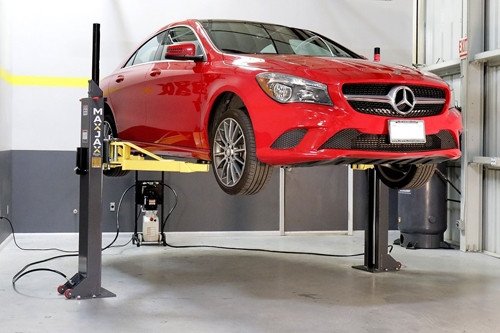
If you have a low ceiling (under 8 feet) and only want to do brake jobs (not storage), the MaxJax Portable 2-Post Lift is designed specifically for you. It stands only 7 feet tall and can be unbolted and rolled away when not in use.
Specific Lift Models by Ceiling Height
We’ve verified overhead dimensions on 600+ lifts in our database. Here’s every model that works under 10 feet, organized by ceiling height. The formula for a 2-post lift: Max rise height + Vehicle height + 3″ minimum clearance = Minimum ceiling required.
8-Foot Ceiling (96 inches)
You’re limited to low-rise and mid-rise lifts. No full-rise 2-post or 4-post will work here.
| Model | Type | Max Rise | Capacity | Power | Works With |
|---|---|---|---|---|---|
| QuickJack BL-3500SLX | Portable scissor | 21.3″ | 3,500 lbs | 110V | Any vehicle under 3,500 lbs |
| QuickJack BL-5000SLX | Portable scissor | 21.3″ | 5,000 lbs | 110V/220V | Sedans, small SUVs |
| QuickJack BL-7000SLX | Portable scissor | 21.3″ | 7,000 lbs | 220V | Most vehicles including trucks |
| Mid-rise scissor lifts (various) | Scissor | 36-48″ | 6,000-9,000 lbs | 110V/220V | Most vehicles |
At 8 feet, a QuickJack with a Miata at 48.4″ tall needs only 48.4 + 21.3 + 3 = 72.7 inches total. That leaves over 23 inches of ceiling clearance. Even a full-size truck (75″ tall) on a QuickJack needs only 99.3 inches — just barely over your 96″ ceiling, so measure carefully.
Mid-rise scissor lifts with 36-48″ of rise are your best option here for real working height under the vehicle.
9-Foot Ceiling (108 inches)
More options open up, including some low-profile 2-post lifts — but only with shorter vehicles.
| Model | Type | Overall Height | Max Rise | Capacity | Min Ceiling (sedan ~57″) | Min Ceiling (truck ~75″) |
|---|---|---|---|---|---|---|
| BendPak XPR-10AS-LP | 2-post asymmetric LP | 11’0″ | 69″ | 10,000 lbs | ~132″ (11’0″) | ~147″ (12’3″) |
| Challenger CL10V3-LP | 2-post low-profile | ~11’0″ | ~69″ | 10,000 lbs | ~132″ | ~147″ |
| All mid-rise scissor lifts | Scissor | N/A | 36-48″ | 6,000-9,000 lbs | 93-105″ | 111-123″ |
| All QuickJack models | Portable | N/A | 21.3″ | 3,500-7,000 lbs | 78-81″ | 96-99″ |
Reality check for 9-foot ceilings and 2-post lifts: Even “low-profile” 2-post lifts have overall heights of 11+ feet. You won’t reach full rise with most vehicles. However, you can still raise a sedan to 36-40″ — enough for oil changes, brake work, and basic undercar inspection while standing on a creeper stool.
10-Foot Ceiling (120 inches)
Now you’re in business. Most low-profile 2-post lifts and many 4-post lifts work at 10 feet with typical sedans and smaller SUVs.
| Model | Type | Overall Height | Max Rise | Capacity | Min Ceiling (sedan ~57″) | Min Ceiling (truck ~75″) |
|---|---|---|---|---|---|---|
| BendPak XPR-10AS-LP | 2-post | 11’0″ (132″) | 69″ | 10,000 lbs | ~132″ | ~147″ |
| Atlas Platinum PV-10P | 2-post | ~11’2″ | ~70″ | 10,000 lbs | ~133″ | ~148″ |
| Triumph NT-9 | 2-post | ~11’0″ | ~69″ | 9,000 lbs | ~132″ | ~147″ |
| BendPak HD-9 series | 4-post | ~82″ (platform) | ~60″ | 9,000 lbs | ~120″ | ~138″ |
| Various 4-post storage | 4-post | 72-82″ | 56-72″ | 7,000-9,000 lbs | Varies | Varies |
At 10 feet with a sedan or sports car: Most low-profile 2-post lifts will give you enough rise for comfortable standing work underneath. You may not reach absolute maximum rise, but you’ll get 60-65″ — enough for most mechanics to stand underneath a sedan without crouching.
At 10 feet with a truck or SUV: You’ll be limited. A Ford F-150 SuperCrew is about 77″ tall. On a 2-post with 69″ max rise, the top of the truck would be at approximately 146″ — 26 inches above your ceiling. You’d max out at about 42-45″ of rise, which is mid-rise territory. For full-rise truck access, you need 12+ feet.
Recommended Approach by Ceiling Height
8-foot ceiling: Get a mid-rise scissor lift. You’ll have 36-48″ of rise, which covers oil changes, brakes, tire rotations, and most maintenance tasks. Skip full-rise 2-post — it won’t work. Budget: $2,000-$4,000.
9-foot ceiling: Same recommendation as 8-foot for most people. A mid-rise scissor is your best capability-to-clearance ratio. If you only work on low-profile vehicles (sports cars, sedans under 56″), a low-profile 2-post might give you partial rise, but measure carefully. Budget: $2,000-$5,000.
10-foot ceiling: Low-profile 2-post lifts are viable for sedans and sports cars. You’ll get near-full rise for vehicles under 57″ tall. For trucks and SUVs, you’re still in mid-rise territory on a 2-post. A 4-post storage lift works well at this height for storing sedans with another vehicle underneath. Budget: $2,500-$6,000.
11-foot ceiling and above: Most standard 2-post lifts work. You’ll have full rise for sedans and good clearance for SUVs. Trucks may still be tight on the tallest lifts. Budget: $2,000-$8,000.
Use our fitment checker to run the exact numbers for your specific vehicle and ceiling height. Enter your garage dimensions and the tool matches you with every compatible lift in our database — no guesswork.
For choosing between lift types, see our 2-post vs 4-post comparison.
Frequently Asked Questions
Q: How much space do I need between the top car and the ceiling?
A: We recommend a minimum buffer of 2 inches. You need this space because to lower the lift, you must first raise it slightly to release the safety locks. If you are tight against the ceiling, you will be trapped.
Q: Can I modify a lift to make the posts shorter?
A: Do not do this. Cutting the posts of a certified lift voids the warranty and destroys its structural integrity. If the posts are too tall for your ceiling, buy a shorter model or cut holes in the drywall (yes, people do this) to let the posts poke into the attic.
Q: Can you put a car lift in an 8-foot garage?
A: Yes, but you’re limited to low-rise and mid-rise options. QuickJack portable lifts (21″ rise) and mid-rise scissor lifts (36-48″ rise) work in any 8-foot garage. Full-rise 2-post lifts require 10+ feet for sedans and 12+ feet for trucks. Mid-rise lifts cover oil changes, brakes, and most maintenance tasks comfortably.
Q: What is the shortest car lift available?
A: The QuickJack BL-3500SLX is one of the lowest-profile lifts available at just 3″ collapsed height with 21.3″ of maximum rise, requiring only about 72-100 inches of ceiling depending on vehicle height. For fixed lifts, mid-rise scissor lifts with 36-48″ rise are the next shortest category.
Q: What ceiling height do I need for a 2-post lift?
A: For a low-profile 2-post lift at full rise: add 69-72″ (max rise) + your vehicle height + 3-6″ clearance. A sedan (57″) needs about 132″ (11 feet). A truck (77″) needs about 152″ (12’8″). You can use a 2-post lift with reduced rise in shorter ceilings, but you won’t reach full standing height underneath.
Q: Do scissor lifts work in low garages?
A: Scissor lifts are ideal for low-ceiling garages. Mid-rise models provide 36-48″ of rise — enough for brake work, oil changes, tire rotations, and basic undercar inspection — while keeping the vehicle low enough to clear an 8-foot ceiling with virtually any passenger vehicle. They’re the most practical lift type for standard residential garages.
Related Guides
Conclusion: Don’t Let 8 Feet Stop You
Space is a luxury, but engineering is the equalizer. If you have two sports cars and a 9-foot ceiling, you are almost certainly “Green Light” for a lift. If you have an 8-foot ceiling, it will be tight, but with the “Hood Swap” method and the right hardware, it is often possible.