
Rotary Lift Review: Models, Parts & Where to Buy [2026]
Rotary Lift is the brand that invented the automotive lift back in 1925, and nearly a century later a Rotary lift is still the benchmark that every other manufacturer is measured against. In this review we break down the current Rotary lift lineup — two-post, four-post, inground and specialty models — plus how to source genuine Rotary lift parts and arms, realistic pricing, and where to actually buy one. If you want commercial-grade lifting that will outlast the building it sits in, Rotary belongs on your shortlist.
In This Article
Rotary sits in the premium tier of the lift market. It is not the cheapest option — budget imports undercut it by thousands of dollars — but it earns its price through engineering, safety certification, and a parts-and-service network that no import brand can match. Before you commit, it helps to understand where Rotary fits among the broader types of car lifts and what you actually get for the extra money.
Quick Verdict
Rotary is the gold-standard commercial lift brand. If you run a shop, plan to lift daily, or simply want a lift you can pass down to your kids, Rotary’s build quality, ALI certification and nationwide parts support make it worth the premium. For occasional home use on a tight budget, a certified mid-tier import may deliver 80% of the value at half the price — but nothing matches Rotary for long-term durability and parts availability.
Who Is Rotary Lift?
Rotary Lift traces its history to 1925, when it introduced the first hydraulic automotive lift and effectively created the vehicle-lifting industry. Based in Madison, Indiana, Rotary is now part of the Vehicle Service Group (VSG), a division of Dover Corporation, which also owns other well-known lift and shop-equipment brands. That corporate backing gives Rotary deep engineering resources and one of the largest distributor and service footprints in the business.
For most of the last century, Rotary lifts have been the default choice for new-car dealerships, franchised service departments, tire chains, and municipal fleets. When you take your car to a dealer for service, there is a very good chance it is going up on a Rotary. That commercial pedigree is the single biggest reason the brand carries the reputation it does — these lifts are designed to be cycled dozens of times a day, every day, for years.
Rotary lifts carry ALI/ETL “Gold Label” certification, which means they have been independently tested to the ANSI/ALI safety standard. This is a meaningful distinction: certification is voluntary, and many budget imports skip it entirely. For a deeper look at why certification matters and how a lift compares to older methods, see our guide on car lifts vs. jack stands.
The Rotary Lift Lineup at a Glance
Rotary’s catalog is broad, spanning everything from a compact two-post for a home garage to massive inground and heavy-duty truck lifts for commercial fleets. For the purposes of this review, the lineup breaks into four families:
- Two-post lifts — the workhorse of most shops; symmetric and asymmetric versions from roughly 9,000 to 18,000 lb capacity.
- Four-post lifts — service and storage lifts with a drive-on platform, great for alignment work, long-term parking, and stability.
- Inground lifts — cylinders set into the floor for a completely open bay; the premium dealership solution.
- Specialty lifts — scissor lifts, low-rise pad lifts, mobile column lifts for trucks and buses, and alignment lifts.
Model designations change over the years, and Rotary periodically refreshes its product families, so always confirm the current model with a distributor. The specifics below reflect long-standing, widely recognized Rotary models and general capacity classes rather than a live price sheet.
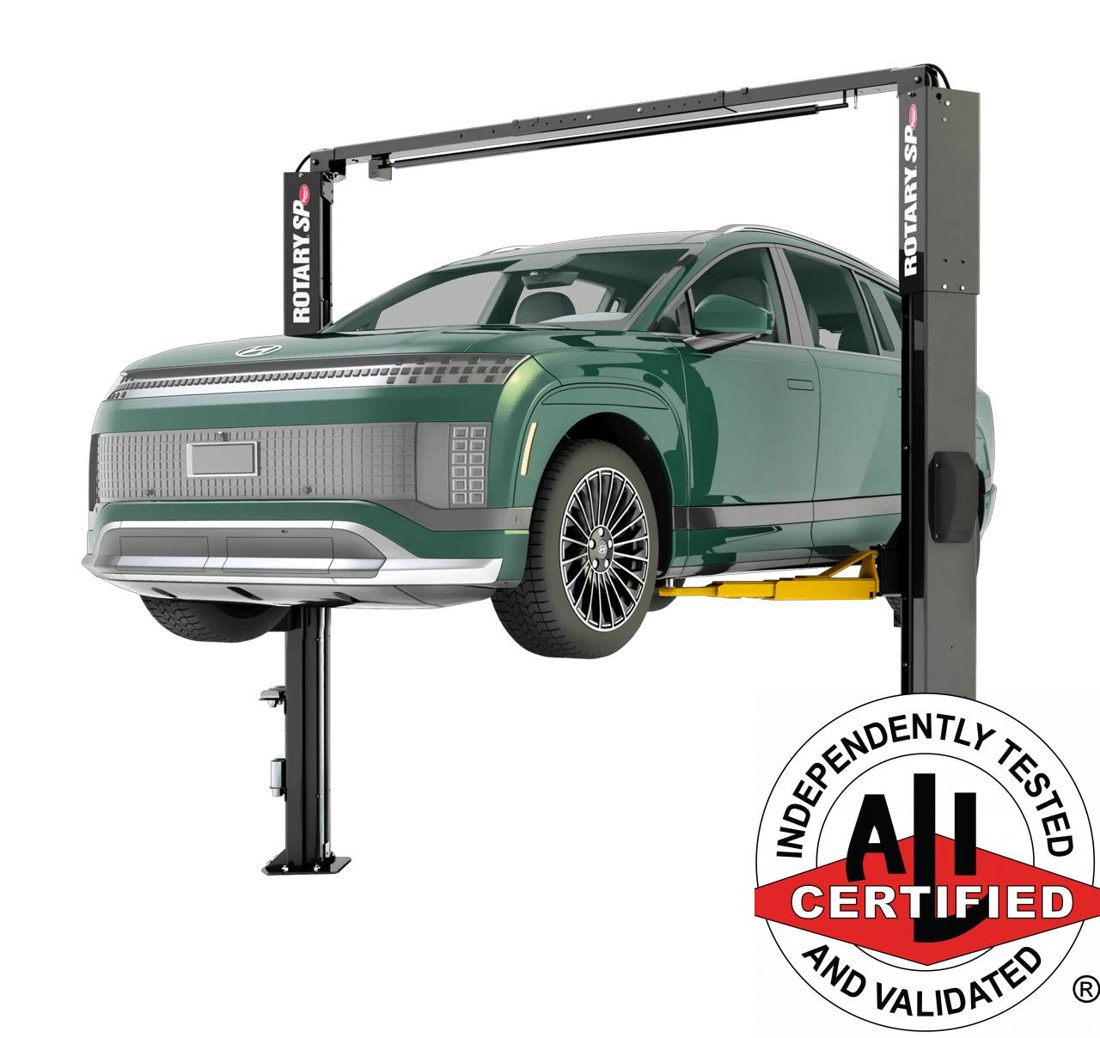
Rotary Lift Model Comparison
Here is how the most commonly specified Rotary families compare. Use this to narrow down which type fits your bay and vehicles before you request a quote.
| Model / Family | Type | Capacity | Key Feature | Approx. Price | Best For |
|---|---|---|---|---|---|
| Rotary SPOA10 | Two-post, symmetric | 10,000 lbs | Balanced load, easy centering | ~$4,500-$6,500 | General service, most cars & light trucks |
| Rotary SPO10 / SPOA10 Asy | Two-post, asymmetric | 10,000 lbs | Rotated columns for door clearance | ~$4,500-$6,800 | Shops that get in and out of vehicles often |
| Rotary SPOA12 | Two-post | 12,000 lbs | Higher capacity for heavier trucks | ~$5,500-$7,500 | Trucks, vans, heavier SUVs |
| Rotary SM122 / Shockwave | Two-post w/ power option | 12,000 lbs | Faster rise (Shockwave option) | ~$6,500-$8,500 | High-volume bays wanting speed |
| Rotary R-Series Four-Post | Four-post, drive-on | 14,000-18,000 lbs | Stable platform, storage friendly | ~$5,000-$9,000 | Alignment, storage, heavy vehicles |
| Rotary Inground (Flush-mount) | Inground piston | 10,000+ lbs | Totally open floor, no columns | ~$10,000-$20,000 installed | Dealerships, premium bays |
| Rotary Scissor / Low-Rise | Scissor pad lift | 6,000-10,000 lbs | Compact, portable options | ~$4,000-$8,000 | Tire, brake & quick-service work |
| Rotary Mobile Column Lifts | Wireless columns | 18,000+ lbs per column | Lifts buses & heavy trucks | ~$20,000+ | Fleet, transit, heavy-duty shops |
Prices above are approximate ranges and fluctuate with configuration, freight, and installation. Treat them as ballpark figures and get a current quote. For a broader sense of what any lift costs to own, our car lift cost guide covers installation, electrical, and hidden expenses.
Two-Post Rotary Lifts
The two-post is the heart of the Rotary lineup and the lift most shops picture when they think of the brand. It uses two columns with swing arms that engage the vehicle’s factory lift points, raising it clear of the ground for full underbody and wheel access. Rotary offers both symmetric and asymmetric configurations.
Symmetric vs. Asymmetric
Symmetric lifts position the columns directly across from each other, splitting the load 50/50. They handle heavy, evenly balanced vehicles well but can make door opening tight. Asymmetric lifts rotate the columns and use different-length arms so the vehicle sits slightly rearward, giving better door clearance for getting in and out. Rotary’s asymmetric two-posts are popular in service bays where techs are constantly opening doors. If you are weighing the two-post format against other designs, our roundup of the best two-post car lifts breaks down the trade-offs in detail.
Two-Post Strengths
- Full underbody and wheel access
- Smaller floor footprint than four-post
- Best for hands-on repair and service work
- Rotary’s certified locks and arm restraints
Two-Post Trade-offs
- Requires proper spotting on lift points
- Needs a thick, level concrete slab
- Not ideal for long-term parking/storage
- Overhead or floor-plate depending on model
Concrete & Installation Requirements
Rotary two-post lifts require a solid, level concrete slab — typically at least 4.25 inches of properly cured concrete for a standard 10,000 lb lift, thicker for higher-capacity units. This is non-negotiable for safety, and it is the same requirement that trips up many first-time home installers. Anchoring into thin or cracked concrete is one of the most common lift-safety failures. If you are planning a home install, our car lift installation guide walks through slab requirements, ceiling height, and electrical.
Four-Post Rotary Lifts
Four-post Rotary lifts use a drive-on runway platform supported by four columns. Because the vehicle sits on its own tires rather than being spotted on lift points, four-posts are faster to load, extremely stable, and forgiving of load placement. That makes them ideal for alignment work (with the addition of slip plates and turnplates), long-term vehicle storage, and lifting heavier vehicles.
Rotary’s four-post lifts range well into the heavy-duty capacities used for trucks and vans. For enthusiasts, a four-post also doubles as a storage lift, letting you stack two vehicles in one bay. If storage or drive-on convenience is your priority, compare options in our best four-post car lifts guide.
Four-post tip: If you want to do repair work (not just storage or alignment) on a four-post, add a rolling bridge jack. It lets you lift the wheels off the runways so you can do brakes, tires, and suspension — turning a storage-oriented lift into a capable service lift.
Inground & Specialty Lifts
Rotary’s inground lifts sink their lifting cylinders into the floor, leaving the bay completely free of columns and runways. This is the premium dealership solution — nothing obstructs the tech, and the clean floor looks professional and is easy to sweep. Inground lifts cost significantly more once you factor in the excavation and installation, but for a permanent, high-throughput bay they are hard to beat.
Beyond the core two- and four-post families, Rotary makes:
- Scissor and low-rise lifts — compact pad lifts, some portable, ideal for tire, brake, and quick-service work where you do not need full standing height.
- Alignment lifts — four-post or scissor platforms with integrated slip plates and turnplates for wheel alignment shops.
- Mobile column lifts — sets of wireless, battery-powered columns that surround a heavy truck or bus and lift it in unison; the go-to for fleet and transit garages.
For most home shops, the two-post or four-post is the right call; the specialty lines are aimed at commercial and fleet operations. If you are still deciding between formats for a home garage, the types of car lifts overview compares them side by side.
Rotary Lift Parts & Arms
One of the biggest reasons to buy Rotary is parts availability. A lift is only as good as your ability to keep it running, and Rotary’s parts network is second to none. Here is what you need to know about sourcing Rotary lift parts and arms.
Common Rotary Lift Wear Parts
- Lift arms & arm assemblies — the swing arms that contact the vehicle; occasionally bent or damaged from misuse.
- Adapter pads — rubber contact pads and stackable adapters that protect pinch welds; a normal wear item.
- Equalizer cables & sheaves — the cables that keep both columns synchronized; safety-critical and inspected regularly.
- Hydraulic cylinders & seals — the power source; seal kits are a common rebuild item on older lifts.
- Lock ladders & latches — the mechanical safety locks that hold the lift at each height.
- Hydraulic components — hoses, fittings, and power units; keep the system topped with the correct fluid (see our car lift hydraulic oil guide).
Rotary Lift Arms
Rotary lift arms are matched to specific models and capacities, and arm restraint systems (the gears or pins that lock the arms in place) are a certified safety feature. If you need replacement arms, buy the genuine Rotary arm assembly for your exact model rather than a universal aftermarket arm — mismatched arms can compromise the restraint system and void certification.
Safety-critical parts warning: For load-bearing and safety components — cables, cylinders, locking latches, arm restraints, and arms — always use genuine Rotary parts sourced by your model and serial number. Generic replacements for these items are a false economy and a real safety risk. Non-critical items like adapter pads have more latitude, but even there, OEM pads fit best.
Where to Get Rotary Parts
Genuine Rotary parts are available through authorized Rotary distributors and Rotary’s parts portal. Have your model number and serial number ready — Rotary parts are keyed to specific serial ranges, and giving the distributor the serial ensures you get the exact match. For routine upkeep, our hydraulic oil guide covers the fluids and intervals that keep the power unit healthy and prevent premature seal wear.
Rotary Lift Pricing
Rotary sits at the premium end of the market. Here is a realistic picture of what you will pay, keeping in mind that prices fluctuate with configuration, freight, and installation:
- Two-post (10,000 lb): approximately $4,500-$6,800
- Two-post (12,000 lb / power options): approximately $5,500-$8,500
- Four-post: approximately $5,000-$9,000
- Inground: approximately $10,000-$20,000 installed
- Mobile column sets: $20,000 and up
By comparison, budget import two-post lifts start around $2,000-$3,000. So a Rotary two-post can cost roughly double a bargain import. What does the premium buy you? ALI certification, heavier steel, better locking mechanisms, a proven track record of decades of daily use, and — critically — parts and service support that will still exist a decade from now. For a full breakdown of lift ownership costs beyond the sticker price, see our how much does a car lift cost guide.
Where to Buy a Rotary Lift
Rotary lifts are sold through an authorized distributor network rather than off the shelf at big-box stores. This is a feature, not a bug: the distributor helps you spec the right model for your bay, arranges freight and often installation, and becomes your parts and service contact for the life of the lift. Your buying options:
- Authorized Rotary distributors — the primary channel; find one through Rotary’s dealer locator. Best for expert spec help and installation.
- Established online equipment retailers — many carry Rotary and handle freight; good for price comparison, but verify they are authorized so your warranty and parts support are intact.
- Directly through Rotary/VSG — for fleet and commercial buyers ordering in volume.
- Used market — Facebook Marketplace, auctions, and shop liquidations (see the next section).
Wherever you buy, confirm the seller is an authorized Rotary channel so you get a genuine, certified lift with valid warranty and parts eligibility. A grey-market or heavily modified lift can lose both.
Buying a Used Rotary Lift
Because Rotary lifts are built to survive decades of commercial abuse, the used market is one of the smartest ways to get one. Shops close, dealerships remodel, and well-maintained Rotary lifts show up for 40-60% of new price. A used Rotary can genuinely be a better buy than a new budget import.
That said, a lift is a safety-critical machine, so inspect before you buy:
- Cables & sheaves: look for fraying, kinks, or corrosion. Plan to replace equalizer cables on any older lift.
- Cylinders: check for leaks and pitting on the rod.
- Locking latches: they should engage positively at every position with an audible click.
- Columns & baseplate: inspect for cracks, heavy rust, or previous impact damage.
- Model & serial: record both so you can source genuine parts and confirm capacity.
Budget for new safety cables, fresh adapter pads, and a hydraulic service. Even with those costs, a sound used Rotary often beats a new import on value and longevity. If a used unit shows cracked columns or a spongy, drifting hold, walk away — that is not a bargain, it is a liability.
Is a Rotary Lift Worth It?
For commercial shops, the answer is almost always yes. When a lift is a revenue-generating tool cycled all day, Rotary’s durability, uptime, safety certification, and parts support pay for themselves. Downtime waiting on parts for a no-name import costs more than the price difference ever did.
For home users, it is more nuanced. If you lift frequently, plan to keep the lift for decades, or simply value peace of mind, a Rotary two-post or four-post is a lifetime purchase you will never regret. If you are a weekend mechanic on a tight budget who lifts occasionally, a well-chosen, ALI-certified mid-tier import can deliver most of the practical value at a lower price — just be honest about the trade-offs in parts availability and long-term durability. Either way, make sure your slab, ceiling height, and electrical are ready first, and consider whether a two-post, four-post, or even a portable car lift best matches your space and how you actually work.
Our Take
Rotary is the brand to buy if you want a lift that outlasts everything else in your garage. It costs more up front, but between ALI certification, commercial-grade build, and unmatched parts support, it is the safest long-term investment in the category. Buy new through an authorized distributor for a shop, or hunt a well-maintained used unit for a home garage — either way, you are getting the lift that started the industry.
Frequently Asked Questions
Is Rotary Lift a good brand?
Yes. Rotary invented the automotive lift in 1925 and is the standard in dealerships and independent shops. Its lifts are ALI/ETL Gold Label certified, built to commercial-duty standards, and backed by a nationwide parts and service network. You pay a premium over budget imports, but the build quality and parts availability justify it for shops and serious home users.
How much does a Rotary Lift cost?
Rotary two-post lifts typically run about $4,500-$6,800, four-posts roughly $5,000-$9,000, and inground lifts $10,000-$20,000 installed. Budget imports start near $2,000, so Rotary can cost about double — but it is commercial-grade and ALI certified. Prices fluctuate; get a current quote from an authorized distributor. See our car lift cost guide for total ownership costs.
Where can I buy Rotary lift parts?
Genuine Rotary parts come from authorized distributors and Rotary’s parts portal. Have your model and serial number ready, since parts are keyed to serial ranges. Use OEM parts for safety-critical items — cables, cylinders, locking latches, arm restraints, and arms — and never substitute generic replacements for those load-bearing components.
What is the most popular Rotary two-post lift?
The 10,000 lb SPOA10 (symmetric) and SPO10 (asymmetric) are among the most widely used two-post lifts in the industry, handling most cars, trucks and SUVs. For heavier trucks, the 12,000 lb SPOA12 is common. Model availability changes over time, so confirm current offerings with a distributor. Compare formats in our best two-post lifts guide.
Are Rotary lifts made in the USA?
Many Rotary lifts are manufactured or assembled in the United States — the brand has operated from Madison, Indiana for decades — though some components may be globally sourced, as is typical industry-wide. If domestic manufacturing matters to you, ask the distributor about the specific model.
Should I buy a used Rotary lift?
It can be an excellent value because Rotary lifts last for decades. Inspect the cables, cylinders, locking latches, and columns before buying, confirm the model and serial for parts, and budget for new safety cables and pads. A well-maintained used Rotary often beats a new budget lift — but have any used lift inspected before first use.