
Best Portable Motorcycle Lifts and Stands: No Permanent Install Required
Best Portable Motorcycle Lifts and Stands: No Permanent Install Required
Not every garage has room for a full-size motorcycle lift table bolted to the floor. When shopping for a portable motorcycle lift, the details matter. Maybe you rent, maybe you share the space, maybe you just need something you can stow in a corner when you’re not wrenching. Portable motorcycle lifts solve that problem — and some of them work surprisingly well.
In This Article
Here’s every type of portable lift and stand available, what each one does best, and which ones are actually worth buying in 2026.
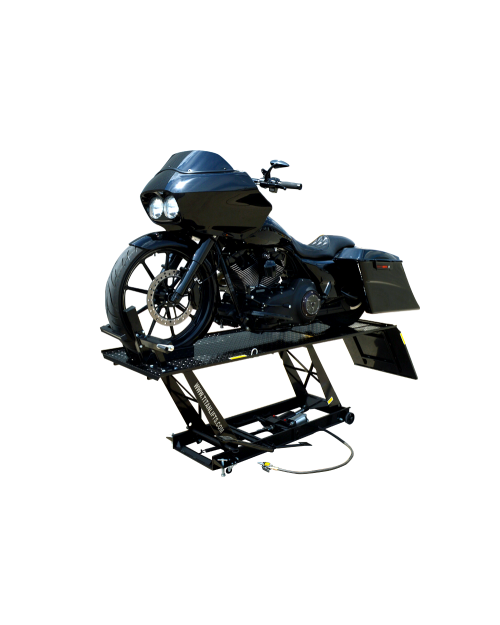
Types of Portable Motorcycle Lifts
The term “portable motorcycle lift” covers a wide range of equipment, from a $40 scissor jack to a $500 folding lift table. Understanding the categories helps you buy the right tool for the job.
1. Scissor Jacks (Hydraulic and Manual)
Scissor jacks are the most popular portable motorcycle lift for home use, and for good reason. They’re compact, affordable, and effective for the majority of maintenance tasks.
How they work: A diamond-shaped scissor mechanism lifts a flat platform under the bike’s frame. Hydraulic versions use a foot pedal or hand pump; manual versions use a threaded rod you turn with a wrench or ratchet.
Lift range: Typically 3.5″ to 14-16″ depending on the model. This won’t get your bike to chest height, but it gets the wheels off the ground and gives you access to the underside.
Best for: Oil changes, chain adjustment and lubrication, brake pad swaps, basic inspections, tire removal (one end at a time).
Limitations: Limited height means you’re still bending or kneeling for most work. Single-point lifting requires the bike to be balanced — you’ll usually need a helper to steady the bike as you position the jack, or use straps to a ceiling beam or rafter.
Top picks:
- Extreme Max 5001.5044 — Hydraulic, 1,100 lbs, ~$55-$70. The default recommendation. Smooth hydraulic action, wide platform, and a proven track record across thousands of owners.
- VEVOR 1,100 lb Scissor Jack — ~$40-$55. Budget option that works fine. Slightly rougher finish but same basic function.
- Powerzone 365030 — Hydraulic, 1,500 lbs, ~$60-$80. Heavier duty option for touring bikes and bigger cruisers.
2. Hydraulic Bottle Jack Adapters
A hydraulic bottle jack with a motorcycle-specific saddle adapter. This is the cheapest way to get a motorcycle off the ground, but it’s also the least stable option.
How they work: Standard bottle jack with a V-shaped or flat saddle on top that cradles the bike’s frame. You pump the handle, the bike goes up.
Lift range: Varies by jack size, typically 6-16″ of travel.
Best for: Emergency lifts, quick jobs where you need one wheel off the ground for 10 minutes. Good for dirt bike work where the bike is lighter.
Limitations: Single-point contact means poor stability. The bike can easily tip if bumped. Not recommended for extended work sessions or heavy bikes. Use only on flat, solid surfaces with the bike strapped for security.
Top picks:
- Torin Big Red Bottle Jack + Motorcycle Adapter — ~$30-$45 for the combo. Gets the job done for light bikes.
3. Paddock Stands (Front and Rear)
Paddock stands are the standard in the sportbike world. Every track day rider owns a set, and they’re excellent for home garage maintenance too.
How they work: Rear stands hook into spools (bobbins) mounted on the swingarm or cradle the swingarm directly. Front stands lift under the lower triple clamp or use pin adapters that go into the front axle.
Lift range: Just enough to get the wheel off the ground — typically 2-4″ of clearance. This isn’t about height; it’s about freeing the wheels.
Best for: Tire changes, chain maintenance, suspension work, wheel bearing inspection, storage (prevents flat spots on tires).
Limitations: Only lifts one end at a time. Doesn’t provide access to the underside of the engine. Not usable on many cruisers and touring bikes that lack spool mounts or compatible frame geometry.
Top picks:
- Venom Sport Bike Stands (front + rear set) — ~$80-$100 for the pair. Excellent quality for the price, fits most sportbikes.
- Pit Bull Hybrid Front + SS Rear — ~$250-$300 for the pair. The gold standard. If you track your bike, these are worth every dollar.
4. Center Stand Lifts / Frame Jacks
These are wider, more stable platforms than scissor jacks, designed to lift the bike from multiple frame contact points simultaneously.
How they work: A broad platform with adjustable contact pads positions under the bike’s frame at two or more points. A hydraulic pump or mechanical linkage lifts the entire platform evenly.
Lift range: Typically 4-18″ depending on the model.
Best for: More stable than a scissor jack for heavy bikes. Good for cruisers and touring bikes that sit low and have accessible frame rails.
Top picks:
- K&L MC450 Center Jack — ~$120-$150. Well-built, stable platform with adjustable pads. Handles bikes up to 800 lbs.
- BikeMaster Center Jack — ~$80-$110. Budget-friendly alternative with similar function.
5. Portable / Compact Lift Tables
These are full lift tables that are designed to be less permanent than a traditional motorcycle lift table. Some fold, some roll on casters, some are just lighter and more compact than standard tables.
How they work: Same scissor-linkage and hydraulic mechanism as a full lift table, just in a smaller, more movable package.
Lift range: 7-30″ or more. These provide near-full working height.
Best for: Home mechanics who want real working height but can’t dedicate permanent floor space to a lift table. Roll it out when you need it, push it against the wall when you don’t.
Limitations: They’re still heavy (150-250 lbs), so “portable” is relative. You’re not carrying these up stairs. But they move on casters and store much more compactly than a full-size table.
Top picks:
- Extreme Max 5001.5083 Wide Platform Lift — ~$190-$220. 1,100 lbs capacity, lifts to 30″. Relatively compact and comes with casters for repositioning. Great balance of portability and function.
- APlusLift MT1500X — ~$350-$450. 1,500 lb capacity with casters and a drop panel for low-clearance loading. More lift table than portable jack, but it moves.
6. Wheel Stands and Chocks
These don’t technically lift the bike, but they hold it upright and stable while you work. Essential accessories for any portable lift setup.
How they work: The front wheel rolls into a V-shaped or cradle-type chock that holds it straight. Some are floor-mounted; portable versions are free-standing with enough weight and rubber grip to stay put.
Best for: Keeping the bike upright and stable while using a scissor jack, doing oil changes, or any work that requires the bike to stand on its own without you holding it.
Top picks:
- MaxxHaul 70271 — ~$30-$40. Simple, effective, adjustable width. The default recommendation for a standalone motorcycle wheel chock.
- Condor Pit Stop / Trailer Stop — ~$80-$120. Premium option that locks the front wheel securely. Great for trailer use too.
When Portable Makes Sense vs. a Full Lift Table
The right choice depends on your situation. Here’s a straightforward decision framework.
| Situation | Best Option | Budget |
|---|---|---|
| Oil changes and chain work only | Scissor jack + wheel chock | $70-$100 |
| Regular maintenance, limited space | Compact lift table with casters | $190-$350 |
| Sport bike, track prep and tires | Front + rear paddock stands | $80-$300 |
| Heavy cruiser/tourer, occasional maintenance | Center stand jack + wheel chock | $110-$180 |
| Regular maintenance, dedicated space available | Full lift table (see guide) | $250-$1,500 |
| Professional or daily use | Full lift table (Handy/BendPak class) | $1,200-$3,000+ |
Renters: Go portable. A scissor jack and wheel chock fit in a closet and work in any parking space. No holes in the floor, no permanent installation, nothing to explain to the landlord.
Shared garages: A compact table with casters is ideal. Roll it out Saturday morning, do your work, push it against the wall. Total footprint when stored is about 7′ x 3′ standing on edge against a wall.
Dedicated garage space: If you have a spot for a full lift table, a full table is almost always the better investment. The working height, stability, and ergonomics of a proper motorcycle lift table transform the maintenance experience. Even a budget Harbor Freight motorcycle lift at $300 is a huge step up from any portable option.
Top Portable Lift Picks by Category
Best Overall Portable Lift: Extreme Max 5001.5083
At $190-$220, this wide-platform hydraulic lift hits the sweet spot. It lifts to 30″, handles 1,100 lbs, and rolls on casters. The platform is wide enough for stable lifting, and the hydraulic pedal system is smooth and reliable. It’s not as tall or stable as a full lift table, but it provides genuine working height in a package you can push into a corner.
Best Budget Portable Option: Extreme Max 5001.5044 Scissor Jack
For under $70, this hydraulic scissor jack handles 90% of routine maintenance. Oil changes, chain work, brake pads, inspections — anything where you need the bike elevated a foot off the ground. Pair it with a $30 wheel chock and you have a complete portable maintenance setup for $100.
Best for Sport Bikes: Pit Bull Front + Rear Stands
If you ride a sport bike, paddock stands are purpose-built for your needs. The Pit Bull set is the gold standard — secure, stable, and designed to last decades. At $250-$300 for the pair, they’re not cheap, but they’re the tool every trackday rider eventually buys after going through cheaper alternatives.
Best for Heavy Bikes: Powerzone 365030 + Condor Chock
For Harleys, Goldwings, and other heavy cruisers, the combination of a 1,500 lb scissor jack and a quality wheel chock provides safe, stable lifting. The Powerzone handles the weight; the Condor keeps the front wheel locked in position. Total investment around $140-$200.
Safety Considerations for Portable Lifts
Portable lifts are inherently less stable than bolted-down lift tables. That’s the trade-off for portability. Here’s how to mitigate the risk.
Always work on flat, solid surfaces. Concrete is ideal. Asphalt can deform under load points. Gravel, grass, and dirt are dangerous — the jack can sink or shift. If your garage floor has a drainage slope, position the lift so any potential tip would go toward the wall, not toward open space.
Secure the motorcycle independently. Don’t rely on the lift alone to keep the bike upright. Use a wheel chock for the front, and tie-downs or ratchet straps to anchor points on either side. This is especially important with scissor jacks that lift from a single center point.
Use mechanical safety locks. If your lift has a safety pin, lock bar, or mechanical stop — use it every single time. Hydraulic systems can fail. Seals can leak. The mechanical backup is what keeps the bike from dropping. Our car lift vs jack stands safety guide covers these principles in detail.
Never work under a bike supported only by a portable lift. If you need to be under the bike (exhaust work, oil pan access), use additional support — jack stands, wood cribbing, or purpose-built safety stands. A portable lift is an elevation tool, not a safety support system.
Check capacity ratings honestly. Manufacturer ratings assume perfect conditions. On a portable lift that might shift slightly, you want more margin than you would on a bolted-down table. Stay at 70-75% of rated capacity rather than the usual 80% guideline.
Weight Capacity Guide by Motorcycle Type
How much lift capacity do you actually need? Here are realistic wet weights (with full fluids and fuel) for common motorcycle categories.
| Motorcycle Type | Typical Wet Weight | Minimum Lift Capacity | Recommended Lift Capacity |
|---|---|---|---|
| Dirt bikes (250cc) | 220-260 lbs | 400 lbs | 500+ lbs |
| Sport bikes (600cc) | 410-460 lbs | 600 lbs | 750+ lbs |
| Sport bikes (1000cc) | 440-500 lbs | 650 lbs | 800+ lbs |
| Naked/standard (650-900cc) | 450-550 lbs | 700 lbs | 850+ lbs |
| Adventure bikes | 500-600 lbs | 750 lbs | 900+ lbs |
| Mid-weight cruisers | 550-650 lbs | 800 lbs | 1,000+ lbs |
| Full-size cruisers (Softail, etc.) | 650-750 lbs | 950 lbs | 1,100+ lbs |
| Touring bikes (loaded) | 800-950 lbs | 1,200 lbs | 1,500+ lbs |
The “recommended” column builds in a 25-30% safety margin, which is appropriate for portable lifts on potentially imperfect surfaces.
Portable Lift Accessories Worth Adding
A few accessories dramatically improve the portable lift experience.
Wheel chock ($30-$120): Mandatory for scissor jack use. Holds the front wheel straight so the bike doesn’t tip sideways. Even the cheapest $30 chock makes a huge difference in stability.
Tie-down straps ($20-$50): Ratchet straps from the handlebars or frame to floor anchors or overhead beams. Prevents the bike from falling off the lift during work. Essential for heavy or top-heavy bikes.
Rubber lift pad ($10-$15): Protects the bike’s frame from scratches where the jack contacts metal. Most scissor jacks include a rubber pad, but replacements and upgrades are cheap insurance for expensive frame paint.
Swingarm spool set ($8-$15): If you’re using paddock stands, these bolt into your swingarm and give the rear stand a secure lifting point. Most sport bikes have threaded spool mounts from the factory.
Making the Decision
If you’re reading this article, you’re probably choosing between two paths: spend $50-$200 on portable equipment, or spend $300-$600 on a permanent lift table.
The portable route makes sense if you’re space-constrained, you rent your garage, or you only do basic maintenance a few times a year. A $70 scissor jack and $30 wheel chock will handle oil changes, chain work, and basic inspections perfectly well.
But if you have the space and wrench on your bike regularly, a full lift table is a better investment. Even a budget motorcycle jack or entry-level table from our motorcycle lift category will provide a better working experience than any portable option. The ergonomic benefit of proper working height — standing up, tools at waist level, everything accessible — is hard to overstate after years of kneeling on concrete. For more on lift safety standards, see Automotive Lift Institute.
For more on choosing the right lift table, check our best motorcycle lift table guide, or browse the best car lifts for home garage if you’re outfitting a full shop.