
The answer
If you're working on heavier bikes or doing suspension and tire work regularly, a hydraulic jack in the $100-$250 range is the sweet spot.
Compiled by Car Lift Lab from verified manufacturer specifications across 600+ car lift models.
Best Motorcycle Jacks for Every Bike & Budget [2026 Guide]
A good motorcycle jack gets your bike off the ground safely so you can actually work on it. When shopping for a motorcycle jack, the details matter. That’s it. But the sheer number of options — scissor jacks, hydraulic jacks, center stands, lift tables — makes a simple purchase feel complicated.
In This Article
- Types of Motorcycle Jacks: What Actually Works
- Motorcycle Jack Capacity Guide: Match Your Bike
- Top Motorcycle Jack Picks: 3 Price Tiers
- Motorcycle Jack Comparison Table
- How to Use a Motorcycle Jack Safely
- When to Upgrade from a Jack to a Lift Table
- Motorcycle Jack vs. Other Lifting Options
- Dirt Bike Jacks: A Quick Note
- What to Avoid When Buying a Motorcycle Jack
- Where to Buy and What to Expect
- Frequently Asked Questions
Here’s the short answer: if you own one bike and do basic maintenance, a $50-$80 scissor jack handles 90% of jobs. If you’re working on heavier bikes or doing suspension and tire work regularly, a hydraulic jack in the $100-$250 range is the sweet spot. And if you’re wrenching every weekend, skip the jack entirely and go straight to a motorcycle lift table.
Now let’s get into the specifics so you buy the right tool for your garage.
Types of Motorcycle Jacks: What Actually Works
Not all motorcycle jacks work the same way, and picking the wrong type for your bike is a fast track to frustration — or worse, a dropped bike. Here’s what’s on the market and who each type is built for.
Scissor Jacks (Best for Budget & Light Use)
Scissor jacks use a simple mechanical linkage — you crank a handle or turn a bolt, and the diamond-shaped frame compresses to raise a saddle plate. They’re cheap ($40-$120), compact, and dead simple.
The trade-off is limited lift height (typically 4-14 inches) and no hydraulic assistance — you’re doing all the lifting manually. They work great for sportbikes, standards, and dirt bikes. For a 900-lb touring bike, they’ll technically work but you’ll want something more stable.
Good scissor jacks have wide rubber-padded saddles, a solid base footprint, and smooth screw mechanisms. Cheap ones have wobbly frames and stripped threads within a year. Spend at least $50 to avoid the junk.
Hydraulic Motorcycle Jacks
Hydraulic jacks use a foot pedal or hand pump to raise the bike — same principle as a floor jack but designed specifically for motorcycle frames. They lift faster, require less effort, and typically handle more weight (1,000-1,500 lbs).
The better models have adjustable saddle widths, rubber padding, and controlled descent valves so the bike lowers smoothly instead of dropping. Prices run $100-$300, with the OTC 1545 and Black Widow models being the most popular in the enthusiast market.
If you’re lifting anything over 500 lbs regularly, hydraulic is the way to go. The effort difference between cranking a scissor jack under a 750-lb Harley versus one pump on a hydraulic is night and day.
Center Stand / Frame Stand Jacks
These are the spool-type or swingarm-type stands that lift the bike from the rear axle or swingarm pivot points. They’re standard equipment in the sportbike world — you’ll see them in every track day paddock.
Rear stands ($40-$80) lift the back wheel for chain maintenance, tire changes, and rear suspension work. Front stands ($50-$100) use the triple tree or fork tubes. Together, they get the entire bike off the ground for about $100-$150 total.
The catch: they require specific lift points on the frame, and they don’t work well (or at all) for cruisers and touring bikes with different frame geometries. Check your bike’s manual for compatible lift points before buying.
Lift Tables (The Upgrade)
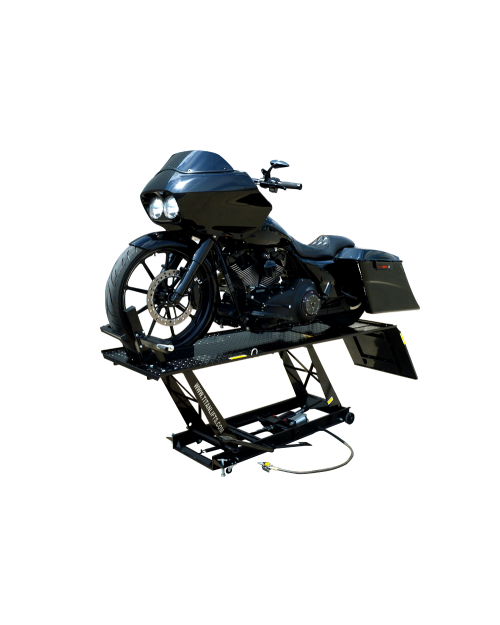
A motorcycle lift table is a full platform that brings the bike to standing work height — roughly 30-36 inches. They include ramps for riding on, wheel vises, and often side extensions. It’s the most comfortable way to wrench on a bike, and once you use one, you’ll never go back to floor-level work.
Tables start around $300 for budget hydraulic models (like the VEVOR options) and run past $2,000 for commercial-grade air-over-hydraulic units from Handy Industries. We cover these in depth in our lift table guide — if you’re considering a table, start there.
Motorcycle Jack Capacity Guide: Match Your Bike
Getting the capacity wrong is the most common mistake. Here’s what different bikes actually weigh (wet, with fluids) and what jack capacity you need.
| Bike Type | Typical Wet Weight | Minimum Jack Capacity | Recommended Capacity |
|---|---|---|---|
| Dirt Bikes (250cc-450cc) | 220-260 lbs | 500 lbs | 500-750 lbs |
| Sportbikes (300cc-600cc) | 350-430 lbs | 750 lbs | 1,000 lbs |
| Sportbikes (1000cc+) | 430-500 lbs | 1,000 lbs | 1,000 lbs |
| Nakeds / Standards | 400-500 lbs | 1,000 lbs | 1,000 lbs |
| Cruisers (Sportster, Bolt) | 500-575 lbs | 1,000 lbs | 1,300 lbs |
| Mid-Size Cruisers (Softail, Indian Scout) | 575-700 lbs | 1,300 lbs | 1,500 lbs |
| Touring (Road Glide, Goldwing) | 800-950 lbs | 1,500 lbs | 1,500 lbs+ |
| Adventure (GS, Multistrada, KTM) | 500-600 lbs | 1,000 lbs | 1,300 lbs |
Rule of thumb: buy a jack rated for at least 1.5x your bike’s wet weight. If your bike weighs 600 lbs, get a 1,000 lb jack minimum. The ratings assume perfect centering and level ground — in the real world, you want headroom.
Top Motorcycle Jack Picks: 3 Price Tiers
Budget Tier: Under $100
VEVOR Motorcycle Scissor Jack — ~$55
The VEVOR scissor jack has become the default budget recommendation, and for good reason. You get a 1,100 lb capacity, a wide rubber-padded saddle, and a lift range of about 3.5 to 13.5 inches. The build quality is solid for the price — heavy-gauge steel, decent welds, and a smooth crank mechanism.
It’s not fancy. The saddle width is fixed, there’s no hydraulic assist, and you’ll be cranking for a while to get a heavy bike up. But for $55, it does exactly what a scissor jack should do. Good for sportbikes, standards, dirt bikes, and lighter cruisers.
Best for: First-time buyers, light to medium bikes, basic maintenance
Torin Big Red Motorcycle Jack — ~$70
The Torin Big Red T64017 is a hydraulic motorcycle jack at scissor jack prices. It has a 1,500 lb capacity, foot-operated hydraulic pump, and adjustable saddle width from about 7 to 11 inches. Lift range is roughly 3.5 to 16 inches.
The hydraulics make a noticeable difference on heavier bikes — instead of cranking, you pump a pedal and the bike rises smoothly. Descent is controlled by a release valve. At $70, it punches well above its weight class. The one downside: it’s heavier and bulkier than a scissor jack, so it doesn’t tuck away as easily.
Best for: Cruiser owners who want hydraulic assist on a budget
Mid-Range: $100-$250
OTC 1545 Motorcycle Lift — ~$190
The OTC 1545 is the jack that independent shops have used for decades. It’s a 1,500 lb capacity hydraulic jack with a wide, padded saddle and extremely smooth pump action. Build quality is a clear step above the budget options — thicker steel, better hydraulic seals, and a controlled-descent valve that actually works precisely.
Lift range is about 3.5 to 17.25 inches, which is enough to get the wheels off the ground on most bikes. The saddle is wide enough for V-twin frames and narrow enough for sportbike frames with the included adapter.
At ~$190, it’s the best pure motorcycle jack you can buy. If you don’t want or need a full lift table, this is the one to get. It’ll outlast three of the budget options.
Best for: Serious home mechanics, Harley and cruiser owners, anyone who wants a “buy it once” jack
Black Widow ProJack Hydraulic — ~$150
The Black Widow ProJack sits between the budget hydraulics and the OTC. You get 1,500 lb capacity, a foot-operated hydraulic pump, wide rubber saddle, and decent build quality. It doesn’t feel as rock-solid as the OTC, but it’s $40 cheaper and does the same basic job.
The included saddle adapters are useful — different shapes for different frame styles. Lift height maxes out around 16.5 inches. A solid mid-range pick, especially if you’re already in the Black Widow ecosystem for other gear.
Best for: Mid-budget buyers who want reliability without paying OTC prices
Premium / Upgrade Tier: $250+
When to Skip the Jack and Buy a Lift Table
Here’s the honest truth: once you’re spending $200+ on a motorcycle jack, you’re getting close to entry-level lift table territory. A basic VEVOR 1,000 lb lift table runs about $300-$400. A mid-range Black Widow lift table is $500-$800.
The lift table gives you everything a jack does, plus working-height access, a built-in ramp, wheel vise, and a stable platform. If you’re spending $250+ and have the floor space, put that money toward a table instead. Your back will thank you every single time you wrench.
Check our full lift table comparison if you’re on the fence.
Motorcycle Jack Comparison Table
| Jack | Type | Capacity | Lift Range | Drive Type | Approx. Price | Best For |
|---|---|---|---|---|---|---|
| VEVOR Scissor Jack | Scissor | 1,100 lbs | 3.5″-13.5″ | Manual crank | $55 | Budget / Light bikes |
| Torin Big Red T64017 | Hydraulic | 1,500 lbs | 3.5″-16″ | Foot hydraulic | $70 | Budget / Cruisers |
| Black Widow ProJack | Hydraulic | 1,500 lbs | 3.5″-16.5″ | Foot hydraulic | $150 | Mid-range all-around |
| OTC 1545 | Hydraulic | 1,500 lbs | 3.5″-17.25″ | Foot hydraulic | $190 | Buy-it-once quality |
| Pitbull Rear Stand | Rear stand | ~500 lbs | Fixed height | Manual | $100 | Sportbikes / Track |
| Venom Front+Rear Set | Stand set | ~500 lbs | Fixed height | Manual | $75 | Sportbike budget set |
How to Use a Motorcycle Jack Safely
Dropping a motorcycle off a jack is one of those mistakes you only make once — because the repair bill ensures you never forget. Here’s how to avoid it.
Step 1: Pick the Right Surface
Flat, level concrete. Period. Gravel, grass, sloped driveways, and rubber mats are all asking for trouble. If your garage floor has a slight slope (most do for drainage), position the bike so it leans slightly into the slope, not away from it.
Step 2: Find the Correct Lift Points
Your owner’s manual specifies jack points. On most bikes, it’s the frame rails underneath the engine, the swingarm pivot area, or designated flat spots on the frame. Never lift from the engine cases, exhaust, or plastic bodywork.
For V-twins (Harleys, Indians), the frame rails near the bottom of the engine are usually your spot. For inline-fours (sportbikes), look for the frame crossmember or use spool-type stands on the swingarm.
Step 3: Stabilize Before Lifting
Put the bike in gear and set the front brake lock if your bike has one. If you’re lifting the front end off the ground, use a wheel chock on the front tire or have a buddy hold the handlebars. For extra stability, run ratchet tie-down straps from the handlebars to ceiling hooks or wall anchors.
Step 4: Lift Slowly and Check
Raise the jack about an inch, then stop and check that the saddle is centered and the bike feels stable. Give it a gentle push from each side. If anything feels sketchy, lower it and reposition. Once you’re confident in the placement, raise to your working height.
Step 5: Use Secondary Support
Anytime you’re doing work that changes the bike’s weight distribution — like removing a wheel — add secondary support. Jack stands, additional jacks, or support stands keep the bike secure even if the primary jack shifts. This is especially critical for tire and suspension work where the bike’s center of gravity changes as you remove components.
When to Upgrade from a Jack to a Lift Table
A motorcycle jack is a great starting tool, but there’s a clear point where upgrading to a lift table makes sense. Here are the signs:
Your back hurts after every wrenching session. Working at floor level for an oil change is fine. Doing a full brake service, valve adjustment, or engine work while hunched over on your knees is a recipe for chronic pain. Lift tables bring the bike to waist height.
You’re working on bikes more than once a month. If you’re wrenching regularly — whether on your own bikes or helping friends — the time you save with a lift table pays for itself. Rolling on, lifting up, and having 360-degree access cuts most job times significantly.
You work on heavy bikes. Lifting and stabilizing a 800+ lb touring bike on a scissor jack is a two-person job that’s always a little sketchy. A lift table with a wheel vise and ramp turns it into a one-person, one-minute operation.
You need the wheels off regularly. Tire changes, brake rotor work, and bearing replacement all require getting both wheels off the ground. That’s possible with jacks and stands, but a lift table with a drop-tail (the rear section lowers to let you roll the rear wheel out) makes it dramatically easier.
If any of those describe you, head to our motorcycle lift table guide and our reviews of the Black Widow lineup and Handy Industries tables.
Motorcycle Jack vs. Other Lifting Options
People often ask how motorcycle jacks compare to other lifting solutions. Here’s the quick breakdown.
Motorcycle Jack vs. Floor Jack with Adapter
A regular automotive floor jack with a rubber adapter plate can technically lift a motorcycle, but it’s not designed for the job. Floor jacks have a narrow saddle, they’re designed for lateral rolling (which you don’t want under a bike), and they lack the lateral stability a motorcycle needs. Purpose-built motorcycle jacks have wider saddles, better frame contact, and more stable bases. The $50-$70 you spend on a proper motorcycle jack is cheap insurance against a dropped bike.
Motorcycle Jack vs. Center Stand
If your bike came with a center stand, that’s actually a great built-in lifting solution for the rear wheel. But it doesn’t lift the front, it doesn’t bring the bike to working height, and not all bikes have them (most sportbikes and many modern cruisers don’t). A jack supplements a center stand — it doesn’t replace one.
Motorcycle Jack vs. Lift Table
Jacks are cheaper ($40-$200), more portable, and take up less space. Lift tables are more comfortable, more stable, and dramatically faster for regular maintenance. If you have the space and budget, the table wins every time. If you’re tight on either, a good jack handles the basics. For more on shop layout and garage lift options, check our home garage guide.
Motorcycle Jack vs. Ramp
A motorcycle ramp gets the bike up onto a platform (like a truck bed or elevated work surface) but doesn’t lift it in place. Ramps and jacks solve different problems — you might use a ramp to load a bike into a truck and a jack to work on it in the garage. They’re complementary, not competing tools.
Dirt Bike Jacks: A Quick Note
Dirt bikes are light enough (220-260 lbs for most 250cc-450cc bikes) that you have more options. A basic scissor jack works fine. So do dedicated dirt bike stands — the simple triangle-shaped stands that lift from the skid plate or frame rails.
The most popular dirt bike jack is the simple MX-style stand that costs $30-$60 and lifts the bike from the frame to a comfortable working height. They’re light enough to toss in a truck for trailside repairs. For a home garage, a scissor jack with at least 500 lb capacity gives you more lift range and adjustability.
For more dirt bike options, see our dirt bike lifts and stands guide.
What to Avoid When Buying a Motorcycle Jack
No-name jacks under $30. The steel is thin, the welds are questionable, and the hydraulic seals (if it has hydraulics) will leak within months. A failed jack under a motorcycle is a $500-$5,000 problem. Spend the extra $20-$30.
Jacks without rubber saddle pads. Metal-on-metal contact between the jack saddle and your frame will scratch paint and, on aluminum frames, can create stress risers. Always use a jack with rubber or polyurethane padding on the contact surfaces.
Undersized jacks. Using a 500 lb jack on a 600 lb bike isn’t just risky — it also wears out the jack faster and makes lifting harder. Oversize your capacity by at least 50%.
Jacks with no safety lock. The better hydraulic jacks have mechanical safety locks or check valves that prevent the jack from lowering if the hydraulic seal fails. If you’re getting under the bike for any reason (exhaust work, oil pan access), a safety lock isn’t optional.
Where to Buy and What to Expect
Most motorcycle jacks are available through Amazon, RevZilla, Cycle Gear, and direct from manufacturers. The budget scissor jacks ship from most retailers within a few days. The OTC 1545 is widely available at auto parts stores and Amazon.
If you’re also looking at portable lifts for other vehicles, many of the same principles apply — capacity, stability, and build quality matter more than brand name. Our scissor lift category has more options for both motorcycles and cars.
For anything beyond basic maintenance — engine work, full restorations, multi-bike shops — the move to a proper lift table is almost always worth it. Start with our lift table buying guide and brand-specific reviews for Black Widow, Handy, and VEVOR to find the right fit.
Need your lift installed?250+ certified installers in all 50 states
Frequently Asked Questions
What size motorcycle jack do I need?
For most standard motorcycles under 600 lbs (sportbikes, nakeds, standards), a 1,000 lb capacity jack is plenty. For touring bikes like a Goldwing or Harley bagger (700-900 lbs wet), step up to a 1,300 lb or 1,500 lb jack. Dirt bikes only need about 300-500 lbs of capacity, so even a basic scissor jack works fine.
Can I use a car jack on a motorcycle?
You technically can use a small floor jack with an adapter plate, but it’s risky. Car jacks don’t have the right saddle geometry, they lack lateral stability, and there’s no built-in wheel chock to keep the bike from rolling. A purpose-built motorcycle jack costs $50-$150 and is far safer.
What’s the difference between a motorcycle jack and a motorcycle lift table?
A motorcycle jack lifts the bike from a single point — usually the frame or swingarm — and typically raises it 4-16 inches. A lift table is a full platform that raises the entire bike to comfortable working height (roughly 30-36 inches), usually with a built-in wheel vise, ramp, and sometimes side extensions. Jacks start around $40; lift tables start around $300.
Are scissor jacks safe for motorcycles?
Scissor jacks are safe when used correctly — the jack is rated for your bike’s weight, you’re on flat concrete, and the saddle makes solid contact with the frame or swingarm. The main risk is lateral instability on uneven surfaces. Always use on level ground and consider tie-down straps to ceiling or wall anchors for extra stability on heavier bikes.
How much should I spend on a motorcycle jack?
For occasional oil changes and chain maintenance, a $50-$80 scissor jack is all you need. For tire changes, suspension work, or regular maintenance on a heavier bike, spend $100-$250 on a hydraulic jack. If you’re wrenching weekly, skip the jack and invest $400-$800 in a proper lift table.
Can I lift a Harley with a scissor jack?
You can lift most Harleys (Sportsters, Dynas, Softails) with a heavy-duty scissor jack rated for 1,500 lbs or more. For touring models like a Road Glide or Street Glide pushing 850+ lbs wet, a hydraulic motorcycle jack or lift table is a much better option. The wider footprint and hydraulic control give you the stability those heavy baggers demand.