
Symmetric
Asymmetric
Asymmetric lifts rotate the columns ~30°, shifting the vehicle rearward so the front doors clear the columns. Best for home garages where you need door access while the car is raised.
They tie on
- Both designs handle 10
Based on verified manufacturer specifications and independent evaluation by Car Lift Lab.
Key Takeaways
- Asymmetric lifts rotate the columns ~30°, shifting the vehicle rearward so the front doors clear the columns. Best for home garages where you need door access while the car is raised.
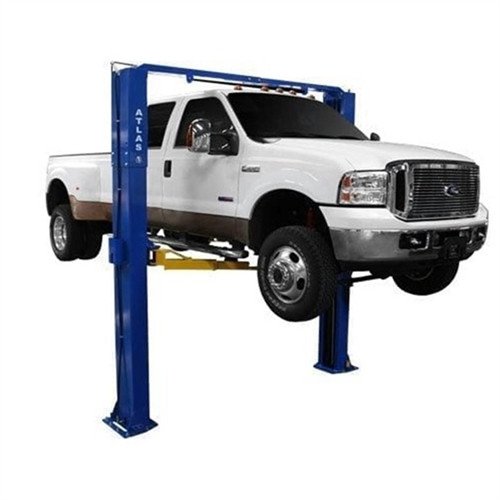
- Symmetric lifts position columns directly opposite each other, centering the vehicle. Best for heavy trucks and commercial shops lifting varied vehicle types.
- Most home garage buyers should choose asymmetric — the door clearance is a practical daily advantage.
- Both designs handle 10,000+ lbs safely. The capacity difference between symmetric and asymmetric versions of the same lift is zero.
- BendPak offers both: XPR-10AS (asymmetric) and XPR-10S (symmetric) at the same price and specs.
- Your vehicle type is the deciding factor: sedans and light trucks → asymmetric. Heavy trucks and balanced commercial loads → symmetric.
- Use the fitment checker to see which lifts fit your garage.
Every 2-post car lift is either symmetric or asymmetric. The difference affects how the vehicle sits between the columns, which vehicles the lift handles best, and whether you can open the doors while the car is raised. It’s a fundamental design choice that matters more than most buyers realize.
This guide explains the engineering behind both designs, shows which vehicles pair best with each, and gives you a clear recommendation based on your specific situation.
How the Designs Differ
Symmetric 2-Post Lifts
On a symmetric lift, the two columns face each other directly. The swing arms extend straight out from each column perpendicular to the column face. The vehicle sits centered between the columns with roughly equal weight distribution front and rear of the column line.
Arm geometry: All four arms are approximately the same length. The front arms reach forward, the rear arms reach rearward. The vehicle’s center of gravity sits at or near the column line.
Column orientation: Columns face each other at 0° — directly across the lift bay.
Asymmetric 2-Post Lifts
On an asymmetric lift, the columns are rotated approximately 30 degrees. This rotation shifts the vehicle rearward relative to the columns. About 30% of the vehicle’s weight sits ahead of the column line and 70% behind it.
Arm geometry: The front arms are shorter than the rear arms (or the arm mounting points are offset) to accommodate the rotated column angle. The arms still contact the vehicle at its designated lift points, but the reach angles differ.
Column orientation: Columns are rotated ~30° from perpendicular, angled slightly toward the rear of the vehicle.
The Practical Differences
Door Access
This is the number-one reason most home buyers choose asymmetric.
On an asymmetric lift, the columns sit behind the front doors. With the vehicle shifted rearward, the driver’s and passenger’s doors swing open freely — you can enter and exit the vehicle, reach the interior controls, and work on the door jambs without obstruction.
On a symmetric lift, the columns sit at the vehicle’s midpoint — directly beside the doors. Depending on the vehicle’s length and door position, the doors may partially or fully contact the columns. You can’t fully open the doors on most sedans and coupes.
Why it matters: If you need to start the engine while the car is up (checking idle, testing AC, running diagnostics), reach the parking brake, shift into neutral, or access interior panels — door access is essential. At home, working alone, you’ll use door access constantly.
Load Distribution
On a symmetric lift, the vehicle’s weight is balanced roughly 50/50 across the column line. This balanced loading puts equal stress on both columns and is mechanically ideal for heavy vehicles where weight distribution matters.
On an asymmetric lift, the weight splits roughly 30/70 (30% ahead of columns, 70% behind). This unbalanced loading is still well within the lift’s engineering — the rotated columns and asymmetric arm lengths account for it. But on very heavy vehicles (approaching the lift’s maximum capacity), the 30/70 split means the rear column bears more load than the front.
Practical impact: For vehicles under 8,000 lbs on a 10,000+ lb lift, the load distribution difference is irrelevant — both designs handle the load with massive safety margins. For vehicles approaching 10,000 lbs on a 10,000-lb lift, the symmetric design provides a more balanced load profile.
Vehicle Fitment
Asymmetric works best with:
- Sedans (Civic, Camry, Accord, BMW 3-Series)
- Sports cars (Mustang, Corvette, Miata, 911)
- Compact and mid-size SUVs (RAV4, CR-V, Highlander)
- Light trucks (F-150 1500-series, Silverado 1500)
Symmetric works best with:
- Heavy-duty trucks (F-250/350, Silverado 2500/3500, RAM 2500/3500)
- Long-wheelbase vans (Sprinter, Transit, ProMaster)
- Commercial vehicles with non-standard lift point locations
- Any vehicle over 8,000 lbs where balanced loading matters
Both handle equally well:
- Standard passenger vehicles at moderate capacity utilization
- Vehicles with standard manufacturer-designated lift points
Arm Positioning
On an asymmetric lift, arm positioning requires awareness of the rotated geometry. The front arms reach forward and inward; the rear arms reach rearward and slightly outward. There’s a learning curve to getting arm placement right, though most technicians adapt within 2–3 lifts.
On a symmetric lift, arm positioning is more intuitive — arms extend straight out from each column in equal pairs. For inexperienced users or shops with high technician turnover, the straightforward geometry reduces positioning errors.
Engineering Deep Dive: Why Asymmetric Is Safe at 30/70
A common concern: “Isn’t 30/70 weight distribution unbalanced? Won’t the rear column be overloaded?”
The short answer: no. Here’s why.
Asymmetric lifts are engineered for the 30/70 split from the ground up. The column rotation angle, arm lengths, arm mounting heights, hydraulic cylinder position, and cable equalization system are all designed around this specific load distribution. The 70% column isn’t overloaded — it’s designed to carry 70% of the rated capacity.
On a 10,000-lb asymmetric lift:
- Maximum rated load per front arm pair: 3,000 lbs (30% of 10,000)
- Maximum rated load per rear arm pair: 7,000 lbs (70% of 10,000)
- Total rated capacity: 10,000 lbs (same as symmetric)
The columns, anchor bolts, and hydraulic system are sized to handle their respective share of the load. This isn’t a compromise — it’s the design specification.
Both the BendPak XPR-10AS (asymmetric) and XPR-10S (symmetric) carry identical 10,000-lb capacity ratings and identical ALI/ETL certification. If the asymmetric design were less safe, it wouldn’t pass the same 150% overload testing.
Vehicle-Specific Recommendations
| Vehicle Type | Recommended Design | Why |
|---|---|---|
| Honda Civic / Toyota Camry | Asymmetric | Light, standard lift points, door access matters |
| Ford Mustang / Chevy Corvette | Asymmetric | Low vehicle, door access essential for cockpit |
| Toyota RAV4 / Honda CR-V | Asymmetric | Standard weight, front-heavy, door access useful |
| Ford F-150 (1500-series) | Either (asymmetric preferred for door access) | Within capacity for both; door access is a plus |
| Ford F-250/350 | Symmetric | Heavy (6,500–7,700 lbs); balanced loading preferred |
| Chevy Silverado 2500/3500 | Symmetric | Heavy (6,500–7,500 lbs); balanced loading preferred |
| Sprinter / Transit van | Symmetric | Long wheelbase, heavy, commercial use |
| BMW 3/5 Series | Asymmetric | Standard weight, door access for cabin electronics |
| Porsche 911 | Asymmetric | Rear-heavy, but well within capacity; door access essential |
BendPak Model Comparison: XPR-10AS vs XPR-10S
| Spec | XPR-10AS (Asymmetric) | XPR-10S (Symmetric) |
|---|---|---|
| Capacity | 10,000 lbs | 10,000 lbs |
| Overall height | 145″ | 145″ |
| Max rise | 69″ | 69″ |
| Rise + pad | 73″ | 75″ |
| Overall width | 137″ | 132″ |
| Arms | Dual-width asymmetric | Dual-width symmetric |
| Certification | ALI/ETL | ALI/ETL |
| Cylinders | HVLP direct-drive | HVLP direct-drive |
| Warranty | 5-yr structural | 5-yr structural |
| Price | ~$5,800–$6,100 | ~$5,800–$6,100 |
Same price, same capacity, same certification. The only differences are arm geometry and overall width (the asymmetric is slightly wider to accommodate the rotated column angle).
See both models on our BendPak review page or the full best 2-post car lifts rankings.
The Bottom Line
For most home garage buyers: choose asymmetric. The door clearance is a practical advantage you’ll use every session. The capacity and safety are identical to symmetric. The 30/70 load split is engineered into the design — it’s not a compromise.
Choose symmetric if: You primarily lift heavy-duty trucks (F-250+, 2500-series+), commercial vans, or vehicles over 8,000 lbs. The balanced 50/50 loading provides more even stress distribution on the columns at high loads. Also consider symmetric if you’re equipping a commercial shop where technicians lift varied vehicles and you want the more intuitive arm positioning.
Not sure which fits your vehicle? Use the fitment checker — it factors in vehicle weight, dimensions, and lift arm compatibility.
Related Guides
Find the Right Lift for Your Garage
Use our free tools to check garage fitment, compare verified specs, and find a certified installer near you.
Frequently Asked Questions
Is asymmetric or symmetric better for home use?
Asymmetric is better for most home users. The ~30° column rotation positions the columns behind the front doors, allowing full door swing for cabin access. Since home mechanics work alone and frequently need to reach the interior (start the engine, set the parking brake, run diagnostics), this access is a practical daily advantage. Capacity and safety are identical between designs.
Can I lift a truck on an asymmetric lift?
Yes — light trucks like the F-150 (4,700–5,700 lbs), Silverado 1500 (4,400–5,300 lbs), and RAM 1500 (4,800–5,600 lbs) are well within asymmetric lift capacity on a 10,000-lb model. For heavy-duty trucks (F-250+ at 6,500–7,700 lbs), symmetric provides more balanced loading and is generally recommended. See our car lifts for trucks guide for truck-specific fitment data.
Does asymmetric reduce the lift's capacity?
No. Both symmetric and asymmetric versions of the same lift carry identical capacity ratings. The BendPak XPR-10AS (asymmetric) and XPR-10S (symmetric) are both rated at 10,000 lbs and both carry ALI/ETL certification at that capacity. The asymmetric design distributes the load differently (30/70 vs. 50/50), but the engineering accounts for this — it’s the design spec, not a limitation.
What does the arm angle look like on an asymmetric lift?
On an asymmetric lift, the front arms extend forward and slightly inward, reaching the vehicle’s front lift points. The rear arms extend rearward and slightly outward, reaching the rear lift points. The arms are different lengths (or offset at different heights) to accommodate the 30° column rotation. After 2–3 vehicles, the positioning becomes intuitive.
Can I convert a symmetric lift to asymmetric?
No. The column rotation angle is built into the baseplate mounting geometry and the arm attachment system. You cannot convert between designs after installation. Choose the right design before buying.