
The answer
Got 8-foot ceilings? A scissor lift fits — no columns, 6,000–7,000 lbs, $1,000–$5,000, and great for brakes, wheels, and oil changes.
Based on verified manufacturer specifications and independent evaluation by Car Lift Lab.
Key Takeaways
- Scissor lifts are the low-ceiling solution: 8-foot ceilings, no permanent columns, 6,000–7,000 lb capacity, $1,000–$5,000. Best for brake, wheel, and oil change work.
- 2-post lifts are the all-around workhorse: full undercarriage access, 9,000–14,000 lbs, $2,000–$7,000. Need 11’+ ceilings. Best for service, repair, and restoration.
- 4-post lifts are the storage-plus-service option: drive-on convenience, doubles as parking, 9,000–14,000 lbs, $2,700–$9,000. Need 11’+ ceilings. Best for collectors and tire/brake work.
- Your ceiling height eliminates options before budget or preference do. Start there.
- Use the fitment checker to see which lifts from all three types fit your garage dimensions.
Three lift types dominate the home garage market. Each one involves a real compromise — there is no single lift that gives you everything. Scissor lifts work in low ceilings but sacrifice rise height. Two-post lifts provide full access but need tall ceilings. Four-post lifts double as parking systems but block center undercarriage access.
This guide puts all three types in the same comparison frame so you can see exactly where each one wins, where it falls short, and which trade-offs match your situation.
The Three-Way Comparison
| Feature | Scissor Lift (Mid-Rise) | 2-Post Lift | 4-Post Lift |
|---|---|---|---|
| Capacity | 5,000–7,000 lbs | 9,000–14,000+ lbs | 9,000–14,000 lbs |
| Max rise | 21–60″ (model-dependent) | 69–80″ | 70–78″ |
| Ceiling needed | 8’+ | 11’–14′ (9’3″ low-profile) | 11’–14′ |
| Undercarriage access | Partial — edges and wheel areas | Full — 360° from any angle | Limited — runways block center |
| Wheel/tire access | Yes (mid-rise models) | Yes — wheels hang free | Requires bridge jacks ($500–$1,200) |
| Vehicle loading | Drive on or position over rails | Position swing arms (2–5 min) | Drive on (30 seconds) |
| Permanent footprint | Minimal — some flush with floor | Two columns (permanent) | Four columns + runways (permanent) |
| Storage capability | None | None | Park second vehicle underneath |
| Power | 110V (some) or 220V | 220V (most); 110V (some) | 220V |
| Concrete anchoring | Some required; portable models: none | Always required | Recommended; some freestanding |
| Installation complexity | Low–medium | Medium–high | Medium–high |
| Price range | $1,000–$5,000 | $2,000–$7,000 | $2,700–$9,000 |
| Best for | Low ceilings, quick jobs | Full service & maintenance | Storage + tire/brake service |
Scissor Lifts: The Low-Ceiling Solution
What They Are
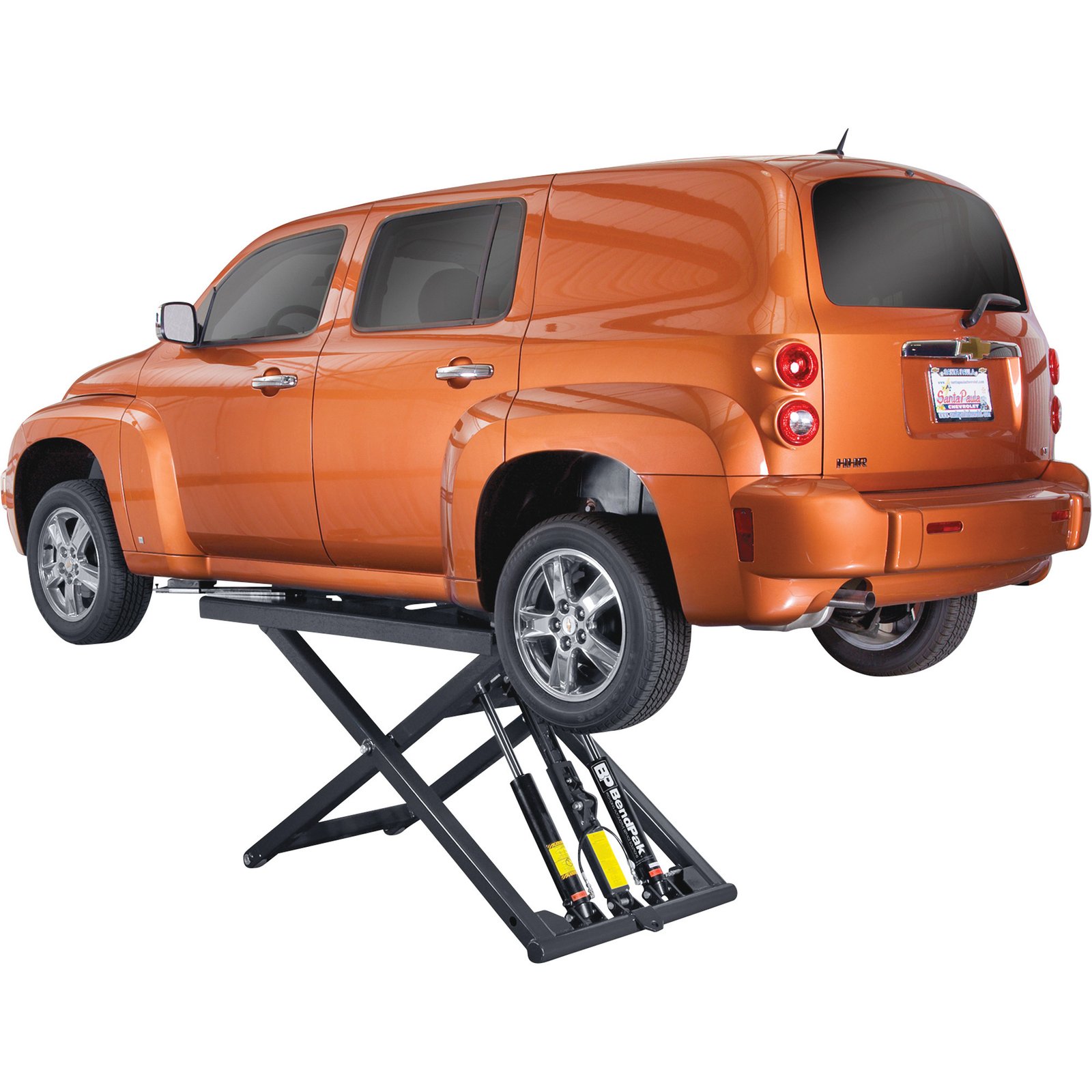
A scissor lift uses a criss-crossed hydraulic mechanism to raise a platform or pair of rails from floor level. No columns. No overhead structure. The entire mechanism sits below the vehicle.
The category splits into two tiers:
Low-rise / portable (QuickJack-style): 5,000–8,000 lbs capacity, 21–24.5 inches of rise. Stores on a shelf or against a wall. $1,000–$2,150. Covered in depth in our portable car lifts guide.
Mid-rise (BendPak MD-6XP-style): 6,000–7,000 lbs capacity, 48–60+ inches of rise. Semi-permanent installation. $3,600–$5,000. Some full-rise models (BendPak SP-7XE) reach 70.5 inches at $10,800+.
When Scissor Wins
Your ceiling is under 10 feet. This is the scissor lift’s strongest advantage. Standard 2-post and 4-post lifts need 11–14 feet. If your garage has 8 or 9-foot ceilings — which most residential garages do — a scissor lift is the only type that provides meaningful rise height.
You want minimal visual impact. Mid-rise scissor lifts sit flush with the floor when lowered. Drive over them, park on top, use the garage normally. When you need to lift, activate the mechanism and the platform rises. No permanent columns visible in the garage.
Your work is wheel-focused. Brake pads, rotors, tire rotations, wheel bearings, CV axles, lower suspension components — mid-rise scissor lifts put all of these at a comfortable working height (waist to chest).
You have limited floor space. No columns to work around. The scissor mechanism’s footprint is under the vehicle, not beside it.
When Scissor Falls Short
You need full standing-height access. Mid-rise models max at 48–60 inches. You’re reaching up or bending down — not standing upright under the vehicle. For transmission drops, exhaust center sections, or anything requiring sustained overhead work, a 2-post lift is dramatically better.
You lift heavy vehicles. 6,000–7,000 lbs covers most sedans and smaller SUVs. Full-size trucks (F-150 at 4,700–5,700 lbs, Silverado at 4,400–5,300 lbs) are at or near the limit. A 2-post or 4-post provides 10,000–14,000 lbs.
You need center undercarriage access. Like a 4-post, the scissor platform sits directly under the vehicle’s centerline. The platform blocks direct access to transmission, transfer case, center exhaust, and fuel tank from below.
Representative Scissor Models
| Model | Type | Capacity | Max Rise | Price |
|---|---|---|---|---|
| QuickJack 5000TL | Low-rise portable | 5,000 lbs | 24″ | ~$1,500 |
| QuickJack 8000TL | Low-rise portable | 8,000 lbs | 24.5″ | ~$2,100 |
| BendPak MD-6XP | Mid-rise | 6,000 lbs | 48″ | ~$3,600 |
| BendPak SP-7XE | Full-rise | 7,000 lbs | 70.5″ | ~$10,800 |
2-Post Lifts: The Versatile Workhorse
What They Are
Two columns bolted to the floor, four adjustable swing arms, hydraulic cylinder. The vehicle rises on its designated lift points to full standing height with nothing blocking access from below.
When 2-Post Wins
You do varied maintenance and repair work. Oil changes on Monday, brake job on Wednesday, transmission swap on Saturday. A 2-post lift handles all of it without modification, supplemental equipment, or compromise. Nothing else in the category offers this versatility.
You need center undercarriage access. Transmission, exhaust, fuel system, driveshaft, transfer case — the entire center of the vehicle is open. Roll a transmission jack underneath, position stands, work from any angle.
You want the best value. A 10,000-lb 2-post lift at $4,500–$6,000 provides more capability per dollar than any other lift type. No bridge jacks needed, no supplemental equipment, full access to every vehicle system.
Your budget is tight. The Triumph NT-9 at ~$3,200–$3,600 with 110V operation is the lowest total-cost path to a full-height lift. No electrician needed, 9,000 lbs capacity, 72 inches of rise.
When 2-Post Falls Short
Your ceiling is under 10 feet. Standard 2-post lifts need 12’+ ceilings. The Triumph NT-9 (111″ overall) works in 9’3″ ceilings, but options below that threshold are effectively zero.
You want to park vehicles on the lift. A car sitting on a 2-post lift’s swing arms is in maintenance position, not storage position. Long-term storage on swing arm pads stresses the vehicle’s body and suspension at four concentrated points. For parking and storage, a 4-post lift distributes weight across the full wheelbase.
You want drive-on simplicity. Positioning swing arms under lift points takes practice and 2–5 minutes per vehicle. There’s a learning curve. Mis-positioned arms can damage rocker panels or miss reinforced lift points. A 4-post lift eliminates this concern entirely.
Representative 2-Post Models
| Model | Capacity | Overall Height | Power | Price |
|---|---|---|---|---|
| Triumph NT-9 | 9,000 lbs | 111″ (9’3″) | 110V | ~$3,200–$3,600 |
| Atlas PV-10PX | 10,000 lbs | 143″–147″ | 220V | ~$4,500–$4,700 |
| BendPak XPR-10AS | 10,000 lbs | 145″ (12’1″) | 220V | ~$5,800–$6,100 |
For the full buyer’s guide with installation details, see our 2-post garage lifts guide.
4-Post Lifts: Storage + Service
What They Are
Four columns and two parallel runways. Drive the vehicle onto the runways, press a button, and the platform rises with the vehicle sitting on its tires. The simplest lift to load and the only type that doubles as a parking system.
When 4-Post Wins
Parking density is your primary goal. Raise one car, park another underneath. This is the unique capability that no other lift type offers (except overhead lifts at 2–3× the price). Car collectors and multi-vehicle households choose 4-post lifts specifically for this.
You value ease of use above all else. Drive on, press a button. Anyone can load a 4-post lift safely — no arm positioning, no lift-point knowledge required. If your family or employees will operate the lift, this simplicity has real safety value.
You work primarily on wheels, tires, and brakes. With rolling bridge jacks, a 4-post lift provides comfortable access to all four wheel assemblies. For detailing shops, tire shops, and hobbyists doing mostly wheel work, the drive-on convenience outweighs the center-access limitation.
When 4-Post Falls Short
You need center undercarriage access. The runways block access to the transmission, center exhaust, fuel tank, and driveshaft. Workarounds exist (sliding between runways, using offset jack positions) but they’re awkward and time-consuming. If you do regular exhaust work, transmission service, or full restorations, a 4-post lift will frustrate you.
You have a single-bay garage. Four columns plus two runways (170–242 inches long) dominate the bay. A 2-post lift’s two columns leave much more open floor space.
Your budget is under $5,000. Budget 4-post lifts start around $2,700, but quality models run $6,000–$9,000 — and you need $500–$1,200 in bridge jacks for wheel work. The all-in cost is significantly higher than a comparable 2-post setup.
Representative 4-Post Models
| Model | Capacity | Runway Length | Price |
|---|---|---|---|
| BendPak HD-7P | 7,000 lbs | ~170″ | ~$5,400 |
| BendPak HD-9 | 9,000 lbs | ~185″ | ~$6,100 |
| Atlas 412 | 12,000 lbs | ~220″ | ~$7,000 |
| BendPak HDS-14 | 14,000 lbs | 242″ | ~$8,300–$8,600 |
The Decision Tree
Step 1: What’s your ceiling height?
| Ceiling | Your options |
|---|---|
| 8–9 feet | Scissor only (or overhead lift for parking) |
| 9–10 feet | Scissor + low-profile 2-post (Triumph NT-9) |
| 10–11 feet | Scissor + more 2-post options + limited 4-post |
| 11–12+ feet | All three types |
If your ceiling eliminates a category, the decision is made for you. No amount of preference overcomes physics.
Step 2: What’s your primary use case?
| Use case | Best type |
|---|---|
| Oil changes, brake pads, basic maintenance | Scissor or 2-post |
| Full service — suspension, exhaust, drivetrain | 2-post |
| Restoration projects | 2-post |
| Parking two vehicles in one bay | 4-post |
| Tire and wheel service only | 4-post or scissor |
| Quick jobs + minimal setup time | Scissor (portable) |
Step 3: What’s your budget?
| Budget | Recommended path |
|---|---|
| Under $2,000 | QuickJack portable scissor ($1,500–$2,150) |
| $2,000–$4,000 | 2-post (Triumph NT-9) or mid-rise scissor (BendPak MD-6XP) |
| $4,000–$7,000 | Quality 2-post (Atlas, BendPak) |
| $7,000–$10,000 | Premium 4-post (with bridge jacks) |
| $10,000+ | Full-rise scissor (BendPak SP-7XE) or premium 4-post |
Can You Own Multiple Types?
Yes, and many serious home mechanics do. Common combinations:
2-post + QuickJack: The 2-post handles heavy work. The QuickJack handles 10-minute oil changes without the time of positioning arms. Total: $4,500–$8,000.
4-post + mid-rise scissor: The 4-post stores vehicles and handles tire work. The mid-rise scissor provides undercarriage access in a second bay for service jobs. Total: $9,000–$14,000.
2-post + 4-post: The dream setup for collectors who also wrench. The 4-post stores vehicles; the 2-post services them. Total: $8,000–$15,000.
If space allows, combining types eliminates the trade-offs entirely. But most home garages only have room for one lift — which brings you back to the decision tree above.
Use the fitment checker to see which lifts of any type fit your garage, or browse by category:
- 2-Post Garage Lifts Guide
- Best 4-Post Car Lifts
- Portable Car Lifts: QuickJack, MaxJax & Alternatives
- Vehicle Lifts: Every Type Explained
Find the Right Lift for Your Garage
Use our free tools to check garage fitment, compare verified specs, and find a certified installer near you.
Frequently Asked Questions
Which type of car lift is best for a home garage?
For most home mechanics, a 2-post lift is the best all-around choice — full undercarriage access, 9,000–14,000 lb capacity, and more versatility per dollar than any other type. If your ceiling is under 10 feet, a mid-rise scissor lift is the practical alternative. If you need to park multiple vehicles in limited bays, a 4-post lift is the right pick. Use the fitment checker to see which models fit your specific garage.
Can a scissor lift replace a 2-post lift?
Partially. A mid-rise scissor lift handles brake work, tire service, oil changes, and lower suspension work at a comfortable height. It cannot replace a 2-post lift for transmission work, exhaust center sections, engine/transmission swaps, or any job requiring full standing-height undercarriage access. If your work stays at the wheels and lower edges, a scissor lift may be sufficient. If you need full access, a 2-post is necessary.
What's the cheapest full-height car lift?
The Triumph NT-9 2-post lift at ~$3,200–$3,600 is the most affordable full-height lift with adequate capacity (9,000 lbs) and rise (72 inches). It also runs on 110V, eliminating electrician costs. Total all-in cost with installation: roughly $3,600–$4,400. No other full-height lift (2-post, 4-post, or full-rise scissor) matches this price point.
Do I need a 4-post lift if I have a 2-post?
Only if you need parking density. A 2-post lift handles every service and maintenance task a 4-post can — plus center undercarriage work that a 4-post cannot. The 4-post adds value only if you need to store vehicles on the lift between service sessions or stack two vehicles in one bay. If service is your only goal, one 2-post lift is all you need.
Which lift type holds its value best?
All three types hold value well on the used market — typically 50–70% of retail for quality brands (BendPak, Atlas). Two-post lifts have the largest used market because they appeal to both DIY mechanics and professional shops. Four-post lifts sell quickly to collectors. Scissor lifts (especially QuickJack) sell well due to their portability and broad appeal.