
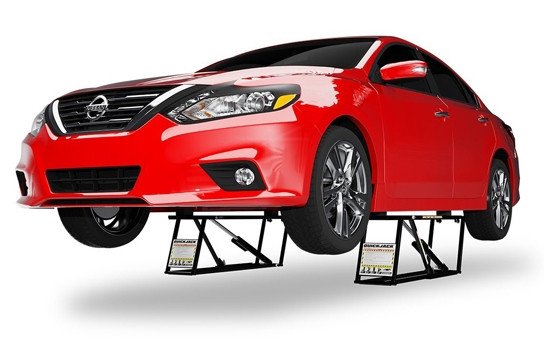
Product verdict
QuickJack
✓ Worth it if QuickJack is better if you need portability and storage (collapses to 3 inches).
Based on hands-on evaluation and verified specifications across the full model lineup by Car Lift Lab.
Key Takeaways
- QuickJack is a BendPak product — same parent company that makes the most respected car lifts in North America.
- The BL-5000SLX ($1,400-$1,600) saves 10-15 minutes per use vs jack stands, covers most passenger vehicles at 5,000 lbs, and stores in 3 inches of space.
- The 21.3-inch rise provides clear access to drain plugs and oil filters on virtually any vehicle.
- QuickJack is better if you need portability and storage (collapses to 3 inches).
- The heaviest QuickJack model (BL-7000SLX) handles 7,000 lbs, covering every consumer passenger vehicle including full-size trucks (F-150 at ~5,600 lbs max) and large SUVs (Tahoe at ~5,900 lbs).
QuickJack is a BendPak product — same parent company that makes the most respected car lifts in North America. That pedigree matters because you’re getting BendPak engineering, hydraulic quality, and support in a $1,100-$2,400 portable package. Whether it’s worth YOUR money depends on what you expect it to do and what you’re comparing it against.
The QuickJack Lineup
| Model | Capacity | Max Rise | Collapsed Height | Power | Weight (pair) | Price Range |
|---|---|---|---|---|---|---|
| BL-3500SLX | 3,500 lbs | 21.3″ | 3″ | 110V/12A | ~135 lbs | $1,100-$1,300 |
| BL-5000SLX | 5,000 lbs | 21.3″ | 3″ | 110V/15A or 220V | ~155 lbs | $1,400-$1,600 |
| BL-7000SLX | 7,000 lbs | 21.3″ | 3.5″ | 220V | ~185 lbs | $2,000-$2,400 |
Which model to buy:
- BL-3500SLX: Covers Miatas, Civics, Corollas, BRZs, and most compact cars. If your heaviest vehicle is under 3,500 lbs, save the $300.
- BL-5000SLX: The sweet spot. Covers most sedans, crossovers, and small SUVs (Camry, RAV4, Model 3, CR-V). 110V power means no electrician needed. This is the model we recommend most often.
- BL-7000SLX: For full-size trucks and SUVs (F-150, Silverado, Tahoe, Tundra). 7,000 lbs handles every consumer passenger vehicle. The trade-off: requires 220V, so you lose the “just plug it in” simplicity.
Real-World Use: What It’s Actually Like
Setup (3-5 Minutes)
- Roll or carry the two frame units to position (each frame weighs 67-93 lbs depending on model)
- Position under the vehicle at the designated lift points — pinch welds on unibody vehicles, frame rails on body-on-frame trucks
- Connect the hydraulic lines (quick-connect fittings)
- Plug in the power unit
- Press the up button
The 3-5 minute setup is realistic for the first few times. After you’ve done it 10-20 times, it drops to 2-3 minutes because you know exactly where to position the frames for your vehicle.
Compared to jack stands: 15-20 minutes to position a floor jack, raise, place stands, lower onto stands, repeat for the second axle. QuickJack is 3-5× faster.
Working Under the Vehicle
At 21.3 inches of rise, you’re working lying on your back — similar to jack stands, but with a few advantages:
- Both sides accessible simultaneously. You can roll from one side to the other to access both wheels, both brakes, the full exhaust path.
- More stable. The frame distributes load broadly and the hydraulic lock holds position. No wobble, no concern about jack stand placement.
- Consistent height. Both sides are level, which matters for jobs like brake bleeding where fluid level and gravity matter.
You cannot sit up, kneel, or stand under the vehicle at 21 inches. This is the fundamental limitation. For oil changes and brake pads, lying down is fine. For exhaust fabrication or transmission work, it’s a dealbreaker.
Storage
Collapsed height is 3-3.5 inches. Each frame unit is about 42-47 inches long. They store flat under a workbench, against a wall, or in a corner. The power unit is a separate box about 12″ × 12″ × 18″. Total storage footprint: roughly 4 square feet of floor space, tucked out of the way.
This is QuickJack’s biggest advantage over every other lift type. When it’s not in use, your garage floor is completely clear.
What QuickJack Does Well
Oil changes: Position, raise, drain, filter, fill, lower. Total time including setup: 20-25 minutes. Vs. jack stands: 40-50 minutes. Vs. driving to a shop: 30-60 minutes + $50-$100.
Brake pad replacement: With the vehicle raised, wheels are accessible from both sides. Remove caliper, swap pads, reassemble. The 21″ rise puts the wheel hub at about shin height — you’re working from a kneeling or seated position. Comfortable enough for a 30-45 minute brake job per axle.
Tire rotations: Raise one end, remove wheels, move to storage, lower, reposition QuickJack, raise other end, swap wheels, lower. Full rotation takes 25-35 minutes. Not as fast as a 2-post lift (10 minutes), but far better than jack stands (45+ minutes with two setups).
Undercar inspection: See brake lines, exhaust components, bushings, fluid leaks — all visible at once with a work light. On jack stands, you only see half the underside at a time.
What QuickJack Doesn’t Do Well
Exhaust work beyond basic repairs. Cutting, welding, and fitting exhaust pipes while lying flat is miserable. You need 50+ inches of clearance to work on exhaust comfortably.
Suspension overhauls. Strut replacement is doable but awkward. Control arms, subframe bushings, and anything requiring significant torque while in an awkward lying position is difficult.
Transmission removal. A transmission jack needs vertical space to lower the trans out from under the car. 21 inches of total clearance minus the transmission’s height leaves almost no room.
Any job lasting more than an hour underneath. The cumulative discomfort of lying on a concrete floor for extended periods is significant. A creeper helps but doesn’t solve the fundamental ergonomic problem.
QuickJack vs Mid-Rise Scissor Lift
| Feature | QuickJack BL-5000SLX | Mid-Rise Scissor (e.g., BendPak MD-6XP) |
|---|---|---|
| Rise height | 21.3″ | 48″ |
| Work position | Lying down | Seated on stool |
| Capacity | 5,000 lbs | 6,000 lbs |
| Power | 110V | 220V |
| Stores flat? | Yes (3″) | No (stays in place) |
| Truly portable? | Yes | Semi (heavy, casters) |
| Concrete anchors? | No | No (most models) |
| Price | ~$1,500 | ~$3,000-$3,800 |
| Best for | Portability + basic maintenance | Comfortable working height + daily use |
Choose QuickJack if: Portability and floor space recovery are priorities. You need to store the lift away between uses.
Choose mid-rise if: Comfort is the priority. You have the floor space for a semi-permanent fixture and want to work seated instead of lying down.
See our full mid-rise car lift guide and best portable car lift guide.
QuickJack vs Entry 2-Post Lift
The price gap between a top-end QuickJack and an entry 2-post is smaller than most people realize:
| QuickJack BL-7000SLX | Triumph NT-9 (2-Post) | |
|---|---|---|
| Purchase | $2,000-$2,400 | $1,800-$2,100 |
| Installation | $0 | $500-$1,500 |
| Electrical | $0 | $200-$500 (if 220V needed) |
| Total | $2,000-$2,400 | $2,500-$4,100 |
For $500-$1,700 more, the 2-post lift gives you 69+ inches of rise (standing underneath), full access for every undercar job, and a permanent setup with no repositioning time. If you have the ceiling height (10+ feet), concrete (4+ inches), and willingness to install, the 2-post is objectively more capable.
QuickJack wins on: no installation, stores flat, works in 8-foot ceilings, no concrete drilling, no electrician (on 110V models).
Resale Value
QuickJacks hold value well in the secondary market. A used BL-5000SLX in good condition sells for $900-$1,100 (60-70% of purchase price). This makes them a low-risk first lift — if you decide you need more capability and upgrade to a full-rise lift, you’ll recover most of your investment on resale.
Browse scissor lifts for mid-rise alternatives, or compare all portable options with verified specs. Use our fitment checker to see if a full-rise lift fits your garage before deciding.
Find the Right Lift for Your Garage
Use our free tools to check garage fitment, compare verified specs across 600+ models, and find a certified installer near you.
Frequently Asked Questions
Is QuickJack worth the money?
Yes, for buyers who need portability and 110V convenience. The BL-5000SLX ($1,400-$1,600) saves 10-15 minutes per use vs jack stands, covers most passenger vehicles at 5,000 lbs, and stores in 3 inches of space. For buyers with ceiling height and concrete for a permanent lift, a full-rise 2-post offers far more capability at $500-$1,700 more installed.
Can you do an oil change with QuickJack?
Yes — it’s one of the best use cases. The 21.3-inch rise provides clear access to drain plugs and oil filters on virtually any vehicle. Total time from setup to lowered: 20-25 minutes, including a 3-5 minute setup. Compare to 40-50 minutes on jack stands or 30-60 minutes at a shop.
QuickJack vs scissor lift — which is better?
QuickJack is better if you need portability and storage (collapses to 3 inches). A mid-rise scissor lift is better for working comfort (36-48 inches of rise vs 21 inches), meaning you work seated instead of lying down. QuickJack starts at $1,100 on 110V; mid-rise scissor lifts start at $2,000 on 220V.
What's the max weight for QuickJack?
The heaviest QuickJack model (BL-7000SLX) handles 7,000 lbs, covering every consumer passenger vehicle including full-size trucks (F-150 at ~5,600 lbs max) and large SUVs (Tahoe at ~5,900 lbs). For 3/4-ton trucks over 7,000 lbs, you’ll need a full-rise fixed lift.